
latest
Sen. Markey defeats Rep. Moulton, will face Deaton in November

Colin Young
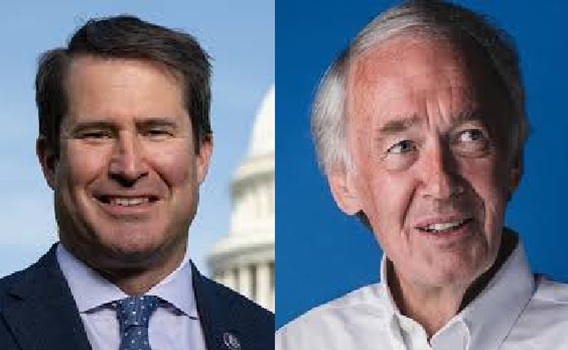
Sept. 1, 2026…..For the second cycle in a row, U.S. Sen. Ed Markey has dispatched a primary challenge from another member of the state’s all-Democrat congressional delegation, cruising to victory Tuesday over U.S. Rep. Seth Moulton and positioning himself one election away from another six-year term.
The Associated Press called the race in Markey’s favor at 8:31 p.m. As of 8:36 p.m., the AP showed 3% of the total votes were counted, split between Markey and Moulton, 74.2% to 25.8%.
The primary win positions Markey to face off against Bolton Republican John Deaton in the Nov. 3 general election. Deaton, who got 40% of the statewide vote in his challenge of U.S. Sen. Elizabeth Warren in 2024 shortly after moving here from Rhode Island, did not have a primary opponent Tuesday.
The Markey-Moulton matchup had all the markings of a defining race of the 2026 cycle for Democrats: it pitted a proud progressive against a more moderate Democrat, and represented a clash between a longtime incumbent and a younger challenger pitching a new approach. The twist to the contest was that the candidate claiming the progressive mantle was not the younger challenger, but rather the longtime incumbent looking to defend his seat in power.
Markey, 80, has said this race will be his last for U.S. Senate. The Malden Democrat joined the U.S. Senate in 2013, after beating fellow Democrat U.S. Rep. Stephen Lynch and then Republican Gabriel Gomez in a special election to fill the seat that U.S. Sen. John Kerry gave up to become secretary of state. Before that, Markey was elected to 18 full terms and two partial ones in the U.S. House of Representatives — he has represented part or all of Massachusetts in Washington D.C. since early November 1976.
Markey said last weekend that the contest between himself and Moulton gave voters “a fundamental choice to make: a choice between progressive values or the status quo,” framing himself as being separate from the status quo, despite his half-century in Congress.
If reelected, Markey has said he will push measures to lower household energy bills and carbon emissions (you don’t hear him say “Green New Deal” nearly as often as in 2020); advocate for Medicare for All and expanding Medicare to cover dental, vision and hearing; continue to push federal legislation to regulate Big Tech and artificial intelligence; support a pathway to citizenship for so-called Dreamers; back abortion protections in the Women’s Health Protection Act; and push to tax ultra-millionaires and “extreme” CEO pay.
On the road toward his third full term in the Senate, Markey again had to run against and outpoll another sitting member of the state’s congressional delegation. In 2020, Markey rebounded from an early polling disadvantage to defeat then-U.S. Rep. Joseph Kennedy III in a competitive primary, 55% to 45%.
Moulton, who turns 48 next month, was elected to the U.S. House six times by voters on the North Shore. The Democrat has not been shy about challenging members of his own party — he won his seat in the U.S. House in 2014 by defeating longtime Democratic Congressman John Tierney, briefly challenged U.S. Rep. Nancy Pelosi for the speaker’s gavel in 2018 and joined a crowded field for president in 2019.

Moulton completed four combat tours in Iraq as an infantry officer in the U.S. Marine Corps. In Salem, he co-founded and was president of Eastern Healthcare Partners.
On the campaign trail, Moulton has argued that the Democratic Party has “clung to the status quo, insisted on using the same old playbook, and isn’t fighting hard enough.” He said he was not challenging Markey because he disagreed with the senator on the issues, but because “this isn’t a fight we can put off for another six years. The future we all believe in is on the line.”
Deaton, a Marine veteran and attorney, earned the Republican Party’s endorsement unusually early in November and has spent much of his time since trying to appeal to the growing base of unenrolled voters and what he calls “disenfranchised” Democrats in Massachusetts. He pitches himself as “a voice for balance, accountability, and practical solutions for working families.”
If sent to Washington D.C., which is currently controlled by Republicans, Deaton said he’d work outside the supermajority to advocate for Massachusetts residents. He has also been open about not voting for fellow Republicans across the country.
“I don’t care who the president is, because I’m going to do that simple test. Is it good in Massachusetts, in America? If it is, I support it. It isn’t, I don’t support it,” Deaton said on the campaign trail.
Massachusetts has not elected a Republican to the U.S. Senate since Wrentham’s Scott Brown defeated Attorney General Martha Coakley in a 2010 special election, and no Republican has been elected to a full term in the Senate since Edward Brooke was reelected to a second term in 1972.
Elizabeth Warren unseated Brown in 2012. He has since moved to New Hampshire and is competing in next week’s Republican primary for U.S. Senate from the Granite State, aiming for the seat being vacated by retiring Democrat Sen. Jeanne Shaheen.
[This is a developing story]
Colin Young is the deputy editor for State House News Service and State Affairs Pro Massachusetts. Reach him at colin.young@statehousenews.com.