
By Sam Drysdale.
Editor’s Note: Elections are about more than who wins. They determine who will govern — and what comes next. The State Affairs 6 focuses on six races, issues or ballot questions in each state that could shape political power and public policy well beyond Election Day. In the weeks leading to Nov. 3, our reporters will explain the people, forces and stakes behind each one — and what the outcome could mean for how Massachusetts is governed.
If voters approve a sweeping public records law in November and Beacon Hill tries to replace it, supporters are ready to sue, adding to a web of possibilities heading into the next legislative term.
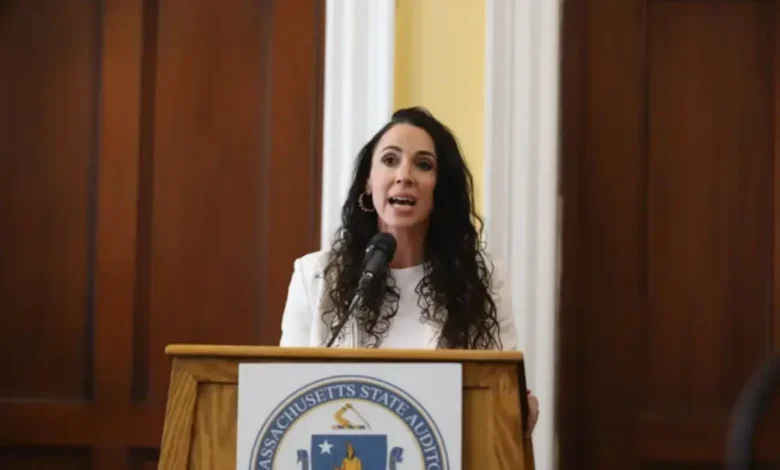
State Auditor Diana DiZoglio says she would “absolutely” consider legal action if lawmakers pass a narrower bill after Question 1 passes, calling the prospect a potential “constitutional crisis.” Massachusetts Fiscal Alliance Executive Director Paul Craney says his group is already talking with national organizations about litigation.
The potential for lawsuits, and the possibility that lawmakers might quickly substitute their judgment for the judgment of voters, means records access reforms are looming as a tricky and impactful topic for governing in 2027.
The post-election fight would put a popular ballot question, the Legislature and Gov. Maura Healey on a collision course over who gets the final word on what records the public would actually get to see and how.
The timing also carries political stakes for Healey, who is seeking reelection.
It is not clear when, or whether, the Legislature will finish its competing open records bill (H 5469 / S 3244). If it reaches Healey before the election, she would face a difficult choice over whether to reject legislation that lawmakers passed before voters had their say. If it arrives after the election, Healey would have to weigh it against a ballot law, should it pass.
Healey did not directly respond when asked whether she would sign or veto a narrower legislative bill to replace a voter-approved Question 1, but her office said she believes the will of the voters should be respected and she would review whether legislation aligns with that intent.
When asked for her position on Question 1 and if her office would comply with the law if it passed, Healey spokesperson Jacqueline Manning said the governor “supports Question 1 to subject the Governor’s Office and the Legislature to the public records law, with appropriate exemptions.”
Republican challenger Mike Minogue was asked the same questions on his position on Question 1, whether he would comply with the ballot law, and if he would sign a narrower version of a public records law, and did not directly respond.
His spokesperson said he “supports all efforts for complete and total transparency.” When asked again for his specific stance on the question and if he would sign a public records bill narrower than what voters approved, she did not reply.
The ballot question would bring most records held by the Legislature and governor’s office under the state’s existing public records law, subject to exemptions including policymaking documents and certain constituent communications. Its place on the ballot is part of a larger reckoning with voter frustration over transparency — Massachusetts is one of two states in the country where the Legislature and governor’s office are not subject to public records law, according to the National Conference of State Legislatures.
A UMass Amherst/WCVB poll in August found 84% of voters said they would definitely or probably support the measure.
House Ways and Means Chairman Aaron Michlewitz acknowledged lawmakers have long expected the question could pass, and “until it does, I think we have to, kind of wait and see,” he said, when asked how the Legislature is thinking about their bills running alongside the ballot question.
The House and Senate are currently negotiating bills that would subject the governor’s office and Legislature to new public records requirements, while creating a separate process for legislative records. Reps. Alice Peisch, Andy Vargas, and David Muradian and Sens. Cindy Creem, Cindy Friedman and Kelly Dooner are on the negotiating committee.
Legislative leaders say their bills pursue the same basic goal as Question 1 while addressing constitutional concerns they say the ballot measure does not.
Legal experts say if they wait until after the election to enact a compromise, the Legislature’s more limited records law could supersede what voters possibly pass. There’s language in both bills declaring them the “sole and exclusive remedy” for obtaining legislative records — language that DiZoglio argues could automatically limit or undermine implementation of Question 1 if voters approve it in November.
Constitutional law professor Lawrence Friedman of New England Law said the most straightforward route for legislators intent on writing the rules around expanded records access would likely be to repeal the voter-approved law and replace it with another statute. There’s precedent for that option: in 2003 the Legislature controversially repealed a law voters approved five years earlier related to public financing of campaigns.
That prospect has supporters of Question 1 preparing for a fight.

“If the bill passes after the election and Gov. Healey signs it, I will absolutely be considering bringing or taking legal action to stand up for the will of the voters,” DiZoglio said. “If legislators are going to be permitted by the courts to, in real time, overturn every ballot initiative they don’t like, we are in a clear constitutional crisis.”
Craney said MassFiscal has already discussed potential litigation with national groups, including the libertarian think tank Goldwater Institute.
“We’ve been talking to national groups about suing the heck out of Massachusetts after this,” Craney said.
Question 1 would put legislative records into the existing public records framework. The legislative proposals instead create defined categories of “legislative records” that can be requested. Both the ballot question and bills generally require the executive offices to open their books.
Settlements and contracts are among the most consequential differences, according to Tufts Center for State Policy Analysis Executive Director Evan Horowitz.
Horowitz said the legislative approach is “narrower,” but cautioned against seeing the two systems as radically different in every respect.
“You can kind of read off exactly how it’s narrower, and probably debate the function of those things, like how important is it that the terms of settlements and contracts become public records?” he said.
For Craney, the protection of settlements and contracts is “absolutely worth that fight.”
“That’s the whole thing that they’re trying to avoid from public scrutiny,” he said.
Question 1 would generally make legislative settlement agreements public, subject to exemptions such as privacy. The Senate President’s office says Senate settlements are already public, but the Senate bill does not specifically list settlement agreements among available records. It would make legislative contracts and procurements public, with exceptions. The House bill also excludes settlements, offering the auditor only a listing of them but not the text, and does not make legislative contracts public.
A spokesperson for House Speaker Ron Mariano said the Legislature is “actively working to achieve the same goal as the ballot question” and that the bill in negotiations addresses “the constitutional considerations necessary to ensure that the reforms can withstand scrutiny and provide a durable framework for greater transparency.”
Senate President Karen Spilka’s spokesperson said the Senate bill “is stronger, clearer, and holds the Legislature more accountable than Question 1, and has clear rules, a tested review process, and real protections for sensitive information, all of which are absent from the ballot measure.”
The conflict is also unfolding against the backdrop of another unresolved ballot fight: DiZoglio’s effort to audit the Legislature under a 2024 voter-approved law. That dispute is already in court, as the Legislature has resisted being audited on constitutional grounds for two years. DiZoglio said she sees the public-records fight as a continuation of that battle.
“What they’re trying to do is, they’re trying to overturn the will of the people in real time,” she said.
The Legislature’s ability to keep the competing bill alive into the post-election period adds another wrinkle.
Under changes to legislative rules this session, lawmakers have more flexibility to return to formal sessions after the traditional end of formal lawmaking, allowing bills put into conference committees by July 31 to move soon after the election rather than waiting to start from scratch in January.
In the past the Legislature has come to compromises with initiative petition supporters ahead of elections to keep certain issues off the ballot, but the new rules mean lawmakers could potentially quickly agree to an alternative to the ballot law shortly after voters render their verdict.
Craney said the old rules were designed in part to prevent lawmakers from using the election-season period to take up controversial legislation.
“It only took one legislative session for the Legislature to be tempted to this mischievous behavior that initially brought those good government procedures in place to begin with,” Craney said.