By Alison Kuznitz and Sam Drysdale.
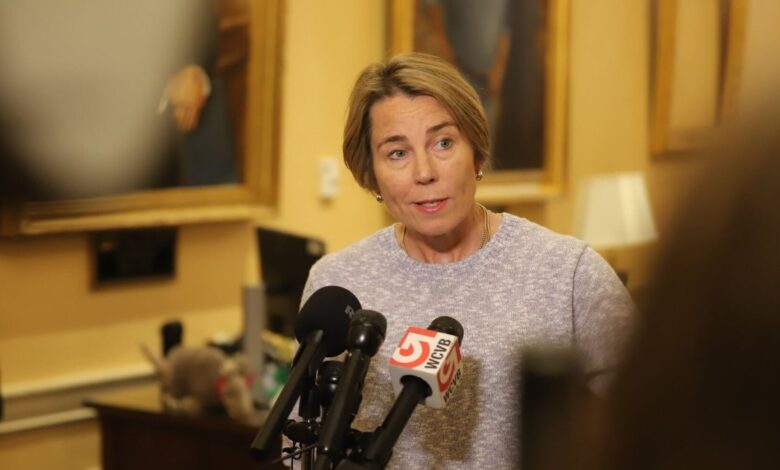
Gov. Maura Healey filed a $2.24 billion supplemental budget Wednesday that would pump more money into the workforce that supports SNAP benefit recipients and establish a new healthcare fund as the state prepares for federal funding cuts.
The state’s existing Health Safety Net Trust Fund, which covers the cost of care for uninsured and underinsured residents, is poised to see a ballooning deficit as residents lose their MassHealth coverage due to policy changes incorporated in the federal One Big Beautiful Bill Act.
The governor’s package calls for the creation of a Health Care Stabilization Fund, which Healey in her filing letter said would “support emerging health care needs, including new costs born from recent federal policy changes.”
“This fund will allow us to house surplus resources to support MassHealth, the Connector, and the Health Safety Net,” Healey wrote.
The bill envisions a funding mechanism for the healthcare account that diverts some excess capital gains that otherwise would go into the rainy day fund. Healey asked lawmakers to enact the bill “promptly” to close the fiscal 2026 books.
The state surtax on high earners has been consistently generating surplus funds that must be spent on education and transportation, according to a constitutional amendment approved in 2022. Non-surtax taxes have experienced less robust growth and fiscal experts over the years have warned against heavy spending of volatile capital gains revenues.
The governor’s bill would steer $41.5 million to the Department of Transitional Assistance, the agency that administers SNAP benefits and is also under acute strain due to the federal law. That amount includes $26.6 million to support DTA caseworkers, which Healey’s office said will enable Massachusetts to retain the 78 new employees hired this year and hire 10 more. It also encompasses about $15 million “to support technology improvements and additional staff support to improve payment accuracy and help the department meet new federal requirements,” Healey’s office said.
Massachusetts is at risk of losing substantial federal revenue if it fails to reduce its error rate for SNAP benefits.

Gov. Healey’s FY 2026 Closeout Budget
Repurposing a pitch from her energy affordability bill, Healey is again proposing overhauling how utility companies purchase electricity for customers on basic service. As Healey faces a reelection challenge this November with affordability on the ballot, the maneuver is expected to save ratepayers $610 million.
Other policy highlights of the bill involve suspending the state’s gas tax for two months in response to higher prices stemming from the ongoing war in Iran and capping the resale price of concert tickets at 110% of the face value of the original ticket. As she detailed last week, Healey also wants to invest $2 million into a home visiting program for parents of newborns and $250,000 to the Massachusetts Child Psychiatry Access Program for Moms.
The bill allocates $1.8 billion in gross funding to MassHealth, which Healey says will shake out to a net cost of $1.03 billion after federal reimbursements. The package includes $134 million for a sheriffs’ reserve account, as well as nearly $6 million to support the Cannabis Control Commission’s work to implement a law overhauling the marijuana industry.
Spending allocated in the $63.4 billion state budget rose by about 3.9% over fiscal year 2026, according to the Massachusetts Taxpayers Foundation. Healey and the Legislature have added to the fiscal 2026 bottom line through supplemental spending bills.
Healey has so far signed two spending bills in fiscal 2026: $300 million for increasing health insurance costs for public workers and a supplemental income surtax spending bill topping $1.4 billion.
Lawmakers adopted a new rule this session permitting them to return to Beacon Hill for election season and lame duck formal sessions on a limited range of matters, including appropriations bills filed after July 31. That means legislators will eventually have an opportunity to debate and amend a House Ways and Means version of Healey’s bill.
[Katie Castellani contributed reporting]