By Alison Kuznitz
Gov. Maura Healey signed an executive order Tuesday subjecting proposed data center projects to local approval before developers can move on to state permitting, representing her administration’s latest crackdown on the facilities after halting tax breaks earlier this summer.
As the artificial intelligence boom marches on, pending data centers in Massachusetts will now need to strike community benefits agreements with host communities that align with state standards before state permitting can get underway. The order also blocks the use of non-disclosure agreements between state agencies and data centers to “ensure a transparent and fair approval process,” Healey’s office said.
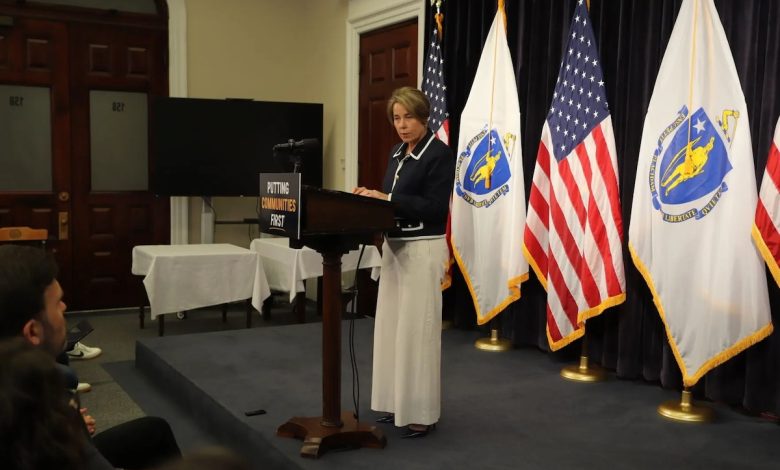
“Unless a community says yes to a data center, we’re saying no,” Healey said at a press conference Tuesday afternoon.
The governor in June paused applications for data center tax incentives, as her administration rolled out a framework for data center development to protect public health and the environment.
The guardrails, which include expectations for securing tax breaks, stipulate that new data centers should directly procure or develop the energy resources to support their operations — without raising energy costs for ratepayers and straining the electric grid. Data centers should also be situated where sufficient water supplies, wastewater and infrastructure capacity exists, and they must minimize air emissions. Communities should also play a “meaningful role” in project planning and development, the administration said.
Under the executive order, data centers projects with peak electricity demand topping 25 megawatts must show they are adhering to the administration’s framework in order to secure permits. The order also creates the “Ratepayer Protection Fund,” which data centers would need to pay into if they are unable to immediately generate their own clean energy.
“We can’t have data centers coming in and taking energy away from the rest of us,” Healey said. “This is another way to make sure that they use clean energy, that we protect and insulate people from increased costs, and that every dollar collected from a data center on this will go back to ratepayers.”
The Massachusetts Department of Environmental Protection is required to develop an alternative compliance payment mechanism by Dec. 31 for data centers that “do not procure sufficient incremental clean electricity to meet their annual electric consumption,” according the order. Those payments would be credited to the Ratepayer Protection Fund.
The governor’s latest steps on data centers come as she seeks to make Massachusetts a place where artificial intelligence can thrive while confronting soaring energy bills and utility ratepayers who can’t keep up with the rising costs.
Fifteen states are considering moratoriums on data center development, according to the National Conference on State Legislatures. Asked why Massachusetts is not pursuing that strategy, Healey invoked her order and said, “I think what’s important here is that we actually have rules — that we have rules in place.”
The governor did not directly answer a question about when her administration will resume accepting applications for the 20-year sales and use tax exemption on qualified data centers. Healey also tried to distance herself from the creation of the tax incentive in 2024 when asked whether her perspective on data centers and AI represents a “political evolution.”
“The sales tax exemption was not my idea. You’d have to ask the Legislature why they included it in the economic development bill package,” Healey said. “I signed the economic development bill package, but I did not include that sales tax exemption in there. But you know, as I’ve seen things, I just didn’t think that it was right for that sales tax exemption to apply in the midst of what we’re dealing with right now, which is a lot of concern across communities in Massachusetts and in this country about the impact that data centers are having or could have.”
Within its energy affordability bill (S 3166), the Senate adopted a Sen. Vanna Howard of Lowell amendment that imposes guardrails that are similar to the Healey administration’s framework for data center tax benefits. In floor remarks, Howard spoke about the repercussions of the controversial Lowell data center, including some residents seeing their electric bills surge by more than 50%, exhaust flowing into residents’ bedrooms and noise keeping them up at night. The legislation remains lodged in conference committee.
Lowell residents in April sued the Massachusetts Department of Environmental Protection for approving a “flawed air quality plan” from the Markley Group, which owns the data center, to install eight new generators and operate a total of 27 diesel generators. A Middlesex Superior Court judge last month temporarily blocked the installation of four diesel generators, while allowing the data center to operate four generators it already installed.
Healey declined to speculate how her executive order, had it been in place sooner, may have impacted construction of the Lowell data center.
“But I do know that it’s really important to have community support, and that’s what my executive order does,” Healey said. “It makes sure that communities have a voice in this, and that anybody who wants to construct a data center has to get the buy-in, has to get the support of a community that typically would come from a community benefits agreement.”
The order tasks the Executive Office of Energy and Environmental Affairs and the Executive Office of Economic Development to publish guidance for municipalities by Dec. 31, aimed at helping them evaluate proposed data center projects and interact with developers.
The 2024 economic development law also carved out $100 million for the Massachusetts AI Hub, and Healey has said she wants to position the commonwealth as a “global leader” in applied AI. She acknowledged Tuesday that AI use has driven up energy demand.
“I think AI makes it all the more important that we take action, and I’m taking action as a state now, trying to get ahead of some of these problems, knowing the amount of energy that we’re going to need going forward,” Healey said. “It’s also why I’ve supported all of the above when it comes to energy sources.”
Energy affordability, and the state’s portfolio of energy sources, is shaping up to be a flashpoint on the campaign trail as Healey looks to secure a second term in office.
Republican gubernatorial candidate Mike Minogue tweeted in January that Massachusetts has 39 data centers, compared to 665 in Virginia. Minogue argued Massachusetts doesn’t have sufficient power “for future manufacturing, hospital services, data centers, innovation hubs, and Life Sciences development.”
“To grow our jobs and economy from last to best, we need gas pipelines and more energy solutions including nuclear energy,” Minogue continued. “I will be the Governor that invests in energy innovation to unleash opportunity.”