BY ELLA ADAMS
Some small property owners are warning that a rent control ballot measure would put them underwater if it is approved.
At the same time, communities like Somerville are “desperate” for housing solutions, Sen. Pat Jehlen told a panel of landlords on Thursday.
The juxtaposition represents the crux of the debate on an initiative petition that could reach voters Nov. 3 that would cap annual rent increases statewide at 5% or the Consumer Price Index, whichever is lower. Rent control bills have failed to gain favor in the decades since a 1994 voter law banned rent control in the state.
“I’ve had people tell me, since it was first debated with the AG’s office last August, that they’re holding units vacant longer, they’re converting to condos, and all this naturally occurring affordable housing in the MassLandlords network is going away already,” MassLandlords Executive Director Douglas Quattrochi said at a briefing. “We really don’t want this to pass, because it will go away even faster if it becomes a reality.”
The campaign supporting the petition, Homes for All, is lauding it as a way to provide housing price stability as tenants face a persistent affordability crisis. The Supreme Judicial Court last Wednesday heard arguments in a challenge to several aspects of the petition.
If the petition were to pass, Springfield small property owner Jasmine Naylor thinks she might have five years left as a landlord. She hasn’t raised her rents in two years, and juggles several jobs so that she doesn’t pass increases onto her tenants.
“I know my tenants. I actually know their names. I know them because they were just like me when I was coming up,” Naylor said. “No landlord wants to displace — and there are bad actors, and we have to acknowledge that there are bad actors in the field, and we’re not shying away from that truth.”
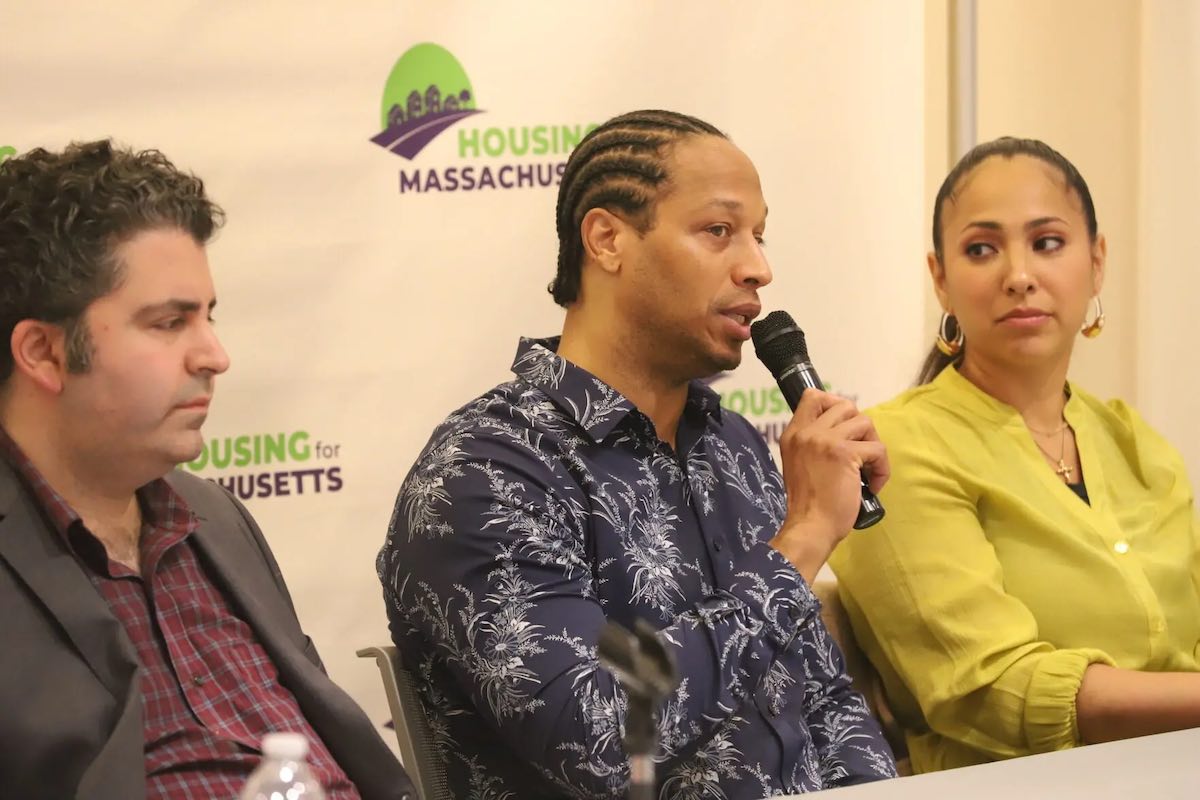
Small property owners make up 60% of rental housing in Massachusetts, opposition campaign Housing for Massachusetts Chair Conor Yunits said. The campaign says the policy would be the most restrictive in the country and implement a “one-size-fits-all” requirement statewide.
“It’s unfortunate to be punished for someone else’s misbehavior in the marketplace when the predominant number of landlords are not misbehaving in terms of the increases that they’re giving, in terms of how they’re maintaining their properties, in terms of the community that they are creating, providing and supporting,” Naylor added.
Sen. Michael Moore referred to a Center for State Policy Analysis and Greater Boston Real Estate Board study that found the proposal could shrink the residential property tax base by 6% to 9% in municipalities across the state, putting pressure on local budgets. Moore said more financial pressure on local revenues would only hurt municipalities, including those pursuing Proposition 2 ½ override requests to safeguard local services.

“Addressing the housing crisis requires a strong partnership between government and the private sector. We need developers willing to build new housing that requires an environment where projects remain financially viable,” Moore said. “If builders and investors do not see a reasonable return on investment, fewer housing projects will move forward, which ultimately means fewer homes for Massachusetts residents. And we all know supply and demand — if there’s less of a supply, what happens to the cost of that housing?”
Small Property Owners Association President Amir Shahsavari said that costs rose during the pandemic and haven’t gone down. He said on average for property owners, utilities costs are up about 39%, property insurance is up 25% to 40%, property taxes are up 21%, and supplies for repairs and maintenance are up roughly 30%. Energy costs, mortgage payments and interest have also risen.
“When you have a policy where rents would be capped at 5% or CPI, whichever is lower — and CPI is typically somewhere in the 2-2.5% range — that’s not enough for us to keep up with expenses, and therefore housing falls into disrepair and problems ensue for both tenants, owners and other stakeholders,” Shahsavari said.
Somerville’s Jehlen has proposed local-option rent control for her district for years.
“The stories are real,” she told opponents. “Your first point is correct, I believe. Not every community is the same. One size doesn’t fit all. But we are desperate in Somerville, and in many other places.”
“The people from Homes for All are willing to find out if there’s a space where you would protect potential homebuyers and renters against displacement and being outbid by large developers — very, very large developers — who will come in with cash and no conditions before the place is on the market. Is there any space to negotiate?” Jehlen asked.
Quattrochi replied that whether the petition is local-option or not is a “huge issue,” but that he sees the main issue being compensation. He said some landlords participate in programs like the Section 8 housing program, which he said is successful because it “recognizes that housing has to be paid for.”
“If the city of Somerville or anyone else wants to allocate an amount, like you allocate for your teachers, to a kind of rent control system that is, in effect, rental assistance — yes, that makes a lot of sense to work together for,” he said. “But as I said before, housing isn’t free, and somehow the cost of it has to be covered.”
Asked if the landlords are advocating for a negotiation with lawmakers, Quattrocchi said, “at this point, it’s kind of too late. It’s going to the ballot.” MassLandlords has advocated for a compensation form of rent control as an alternative.
Yunits countered: “We’re going to defeat this in November. And we’re going to do it through the small property owners like these folks here.”
The SJC case is ongoing. The court says most cases are generally decided within 130 days of oral arguments. Justices typically move more quickly on cases that involve ballot questions.