
BY ELLA ADAMS
Senate Democrats on Monday announced their fiscal 2027 budget bill would bump unrestricted government aid for cities and towns up by $53 million, or 4%, and introduce a new formula for the additional allocation.
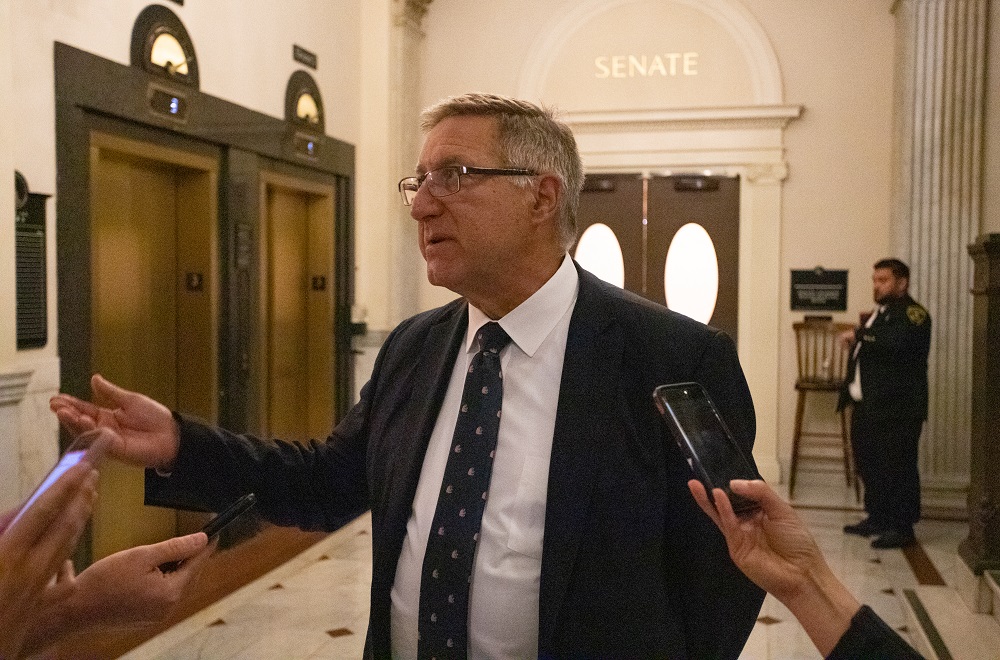
Senate Ways and Means Chair Michael Rodrigues said the new unrestricted general government aid (UGGA) — a flexible state funding source for cities and towns — will be distributed on a per-capita basis.
“Currently there is no formula for distributing unrestricted general government aid,” Rodrigues said at a State House press conference. He described the proposed formula as “a much fairer way to distribute the increase in UGGA funding” because every community will see an increase in allotments through the proposal.
The Senate budget will propose a total of $1.376 billion in unrestricted local aid funding, Rodrigues said. While Senate President Karen Spilka called it the “highest local aid investment in history,” the proposal falls well shy of the amount municipal officials say is needed to make up for underfunding and address ongoing costs.
Of the total, $1.323 million — the amount provided in the fiscal 2026 budget — would be distributed as it has historically been, Rodrigues said. The $53 million would be distributed differently.
He called the formula a “pretty easy” one.
“You take the total population, divide that into $53 million and that’s how much per head each community will receive in additional funding above and beyond the baseload level funding,” Rodrigues said. “We will have, for every member, a chart of distribution — a schedule of what their communities can expect to receive above and beyond what the House passed in its version two weeks ago.”
Asked how the UGGA funding was divvied up beforehand, Rodrigues said, “Nobody knows.”
“It was literally established back when they established the state Lottery to provide support for local communities. It was called lottery aid for years,” Rodrigues said, adding that around 2008, it became apparent that the revenue generated by the lottery alone wouldn’t be “sufficient” to meet local needs.
“So we started adding additional assistance through general operating funds, and we just basically, whatever that percentage was, whatever your allocation was the year before, everyone got that percentage. So if it was not based upon an equitable standard to begin with, it just got compounded over the years,” Rodrigues continued.
There would be a 4% cap on the amount of aid communities can receive under the proposed formula, the Westport Democrat said.
Gov. Maura Healey’s fiscal 2027 budget proposes that the state increase UGGA by 2.5%, or $33 million, which her administration said remains in line with projections of state tax revenue growth. H 2 proposes a total of $1.356 billion in funding for UGGA, per the administration.

The House last week passed a fiscal 2027 budget proposal that would fund UGGA at $1.33 billion, after extensive discussion about local aid. The House budget funds overall local aid higher than Healey’s does. The Senate’s total local aid allocation will be released on Tuesday, when the full Senate Ways and Means budget is.
A report from the Massachusetts Taxpayers Foundation looking at local aid and K-12 spending in Healey’s fiscal 2027 budget found that if UGGA funding had reflected actual tax revenue growth trends between fiscal 2016 and fiscal 2026, the local aid appropriation would be about $300 million larger because local aid increases haven’t reflected actual tax revenue growth.
According to an October 2025 Massachusetts Municipal Association report, when adjusted for inflation, UGGA funding has fallen 25% overall since 2010.
The proposals from Healey, the House and Senate do not meet the fiscal 2027 request from the MMA for a $351 million UGGA increase, or 26.5% rise, over fiscal 2026 levels.
But MMA Executive Director and CEO Adam Chapdelaine expressed “deep appreciation” for the Senate proposal.
“In the context of everything we talked about, all the challenges the state is facing, the challenges that are happening on the local level, we are very pleased to see these proposed investments,” Chapdelaine said. “We think it begins this acknowledgement of how serious the need is, and makes a significant investment in the face of so many other challenges.”
Rodrigues said he heard from “every single one” of the senators about local aid needs during one-on-one Senate budget meetings. Municipalities are being impacted by rising costs in municipal health care, special education and collective bargaining agreements, he said, while facing limited new growth and inflation and working within the constraints of Proposition 2 1/2. Cost constraints are leading to things like reductions in public safety officials and increases in class sizes, he added.
“We are struggling. We are absolutely struggling, because, like the chair said, you have to make hard decisions, and we’re making hard decisions, and our residents are not happy,” Sharon Select Board Chair and MMA Vice President Kiana Baskin said.
During the House budget debate last Wednesday, several Republican representatives spoke of the struggles cities and towns are facing while trying to balance their budgets. Republicans proposed increasing UGGA in various manners, though nearly every Democrat rejected each Republican local aid amendment. Outgoing House Minority Leader Brad Jones lost his final budget amendment on a local aid proposal.
“I just don’t understand — I find it interesting that we’ve now gotten to a mindset where we say if we can’t even do a lot, we’re not going to do a little,” Jones said.
Rep. Alyson Sullivan-Almeida said rising costs have led to “a sharp increase” in Proposition 2 1/2 override requests.
“These overrides are not happening because our communities want to raise taxes. They’re happening because they feel that they have no other options,” Sullivan-Almeida said.