
latest
Rent Control, Tax Cuts, Open Primaries Among 10 Massachusetts Ballot Questions Still Alive for 2026

BY ELLA ADAMS, SAM DRYSDALE & ALISON KUZNITZ
Campaigns backing at least 10 of the 44 filed ballot question proposals believe they’re still in the running to make it onto the 2026 ballot, while the majority of petitions have died before the election year even begins.
Supporters of rent control, improving public records access, reducing the income tax, starter home construction and all-party primaries are among proposals still in the mix. Most of the campaigns still in the running paid people to gather the tens of thousands of signatures needed to keep proposals in the pipeline.
Initiative petition campaigns had about two months under state law to gather at least 74,574 signatures and submit them at the local level by Wednesday for certification — a checkpoint that historically thins the field. No more than 25%, or 18,643, of the total required signatures may come from any one county. The locally-certified signatures then must be filed with the secretary of state by Dec. 3.
A record 44 proposals were certified as ballot eligible by the attorney general this year, constituting 40 proposed laws and four constitutional amendments.
Voters will not get to weigh in on the majority of those proposals, including ones that would have enabled incarcerated people with felony convictions to vote; allowed some employees otherwise ineligible for Paid Family and Medical Leave benefits to choose to pay into the program; and enabled voters to initiate recall elections to remove elected officials from office. Campaigns supporting the measures told the News Service that they did not collect enough signatures by Wednesday’s deadline.
Others that didn’t hit the mark include proposals to cap residential and commercial property tax increases; require a person to be present in all Massachusetts-registered autonomous vehicles when they transport passengers, services or goods; and to require companies that design, manufacture or install digital, internet or wireless technology or services to make design choices that reduce electromagnetic radiation exposure.
Campaigns backing questions that would require Massachusetts voters to provide photo identification, require that statewide voter registration rolls are made publicly accessible, and repeal the legalization of recreational marijuana could not confirm to the News Service how many signatures they submitted to local clerks’ offices.
Wendy Wakeman, spokesperson for the coalition promoting a recreational cannabis repeal, said she’s “not sure” how many signatures they submitted, but is “certain we have submitted enough that we are going to pass through.” Chair of the Committee for Massachusetts Voter Identification Ballot Question, Jeff Cohen, said that backers of voter ID and public voter rolls questions are “hopeful” they collected enough signatures.
Cohen noted that his campaigns’ signatures were gathered only by volunteers, representing one of few campaigns that told the News Service they didn’t utilize paid signature gatherers. The single campaign confident that its question will survive local certification that did not hire paid signature gatherers was Homes for All Massachusetts, the coalition backing a rent control proposal, according to campaign spokesperson Andrew Farnitano. Most campaigns used a combination of paid signature gatherers and volunteers.
The first legislative day of the new year (Jan. 7) serves as yet another checkpoint, when successful petitions are filed as bills with the House Clerk’s office. Lawmakers get a chance to address the petitions themselves — which would eliminate the need for a ballot question — but Beacon Hill often chooses to let the voters decide.
If the Legislature does not pass the measure as filed by the first Wednesday in May (May 6), a petitioner must then collect 12,429 more signatures and file them with local election officials for certification by June 17. After enough signatures are filed, the measure is then placed on the ballot for the next statewide general election.

The 10 petitions whose campaigns believe they’re still in play include:
All-party primaries: The measure that would eliminate political party primaries for state elections submitted 98,000 “internally-validated” signatures, according to Coalition for Healthy Democracy campaign manager Jesse Littlewood, who said he is confident the question will move forward. The campaign collected signatures for “Version B” of the question, which would list all candidates, regardless of their party affiliation, on one primary ballot. The general election would consist of the top two vote-getters plus a write-in option, Littlewood said. The question would also provide party status to any group whose candidates for any statewide office received at least 3% of the ballots cast in the state primary. “We’ve had great conversations across the state. The voters we’re speaking to who are enthusiastic about this want more competition in their elections, want elections where they can hold politicians accountable and want officials to represent all of their voters,” Littlewood said. – Ella Adams
Committee for Public Counsel Services collective bargaining: The campaign backing the ballot measure that would permit employees of the Committee for Public Counsel Services to collectively bargain submitted 110,000 signatures, according to SEIU Local 888 president Tom McKeever. He said Thursday that more than 75,000 of those have already been vetted by local clerks’ offices. The campaign is a partnership between SEIU and the National Association of Government Employees. “They are state employees in every way and they want to have the decision to collectively bargain just like 180 other state agencies and their state employees currently have,” McKeever said of the public attorneys. “Once this initiative is complete, it doesn’t bring them a union, but recognizes CPCS as employees that can choose to have a union.” – Ella Adams
Election Day voter registration: The measure that would permit eligible voters to register or update their voter registration status on Election Day submitted well over 80,000 signatures and is potentially closing in on 90,000, according to Secretary of State William Galvin, who launched the campaign. Following past successful voting rights efforts, like those implementing mail-in voting and automatic voter registration, Galvin called the proposal an “important final step” to “perfect the rights of voters in Massachusetts.” Registration limitations tend to “adversely affect younger people, poorer people and people who live in cities,” he added, as they fall disproportionately on people who rent and move around a lot. Despite same-day registration being presented to Beacon Hill lawmakers for years, it’s been met with resistance. “The only way to get it done is to get it to the people, and that’s what we’re doing,” Galvin said. – Ella Adams
‘Nature For All’ Fund: Supporters of a potential 2026 voter referendum that could generate $100 million annually for conservation and restoration efforts around water and nature collected more than 100,000 signatures, spokesperson Andrew Farnitano said Tuesday. The measure would steer sales tax revenue from sporting goods like golf clubs, RVs and camping gear into a new “Nature for All Fund.” The petition’s goal is to conserve or restore land to protect drinking water, streams, rivers, lakes, coasts, farms and forests. Funding could also support land and natural resources with “indigenous cultural significance.” – Alison Kuznitz
Public records law: Auditor Diana DiZoglio announced Wednesday that the campaign supporting a ballot measure that would subject most records held by the Legislature and the governor’s office to the Massachusetts public records law has submitted more than 100,000 signatures. DiZoglio’s 2024 ballot question to audit the Legislature passed with majority support by voters last fall, though the effort has since been stalled due to what Beacon Hill Democrats say are concerns of constitutionality. – Ella Adams
Income tax rate reduction: The measure that aims to reduce the state’s personal income tax rate from 5% to 4% over the course of three years submitted 87,200 raw signatures, according to campaign manager and Pioneer Institute Executive Director Jim Stergios. He called it “plenty of cushion to get to the number we need” to meet the threshold. “We are very comfortable that where people are, they feel very hard pressed right now. The polling levels — 70 to 80% of people want a tax cut. If you look at union members, they themselves want a tax cut by a strong majority,” Stergios said, referring to Pioneer Institute polling and pointing to high costs as a major pressure. The proposal would set tax rates for personal taxable income at 4.67% for tax year 2027, 4.33% for 2028, and 4% for 2029. – Ella Adams
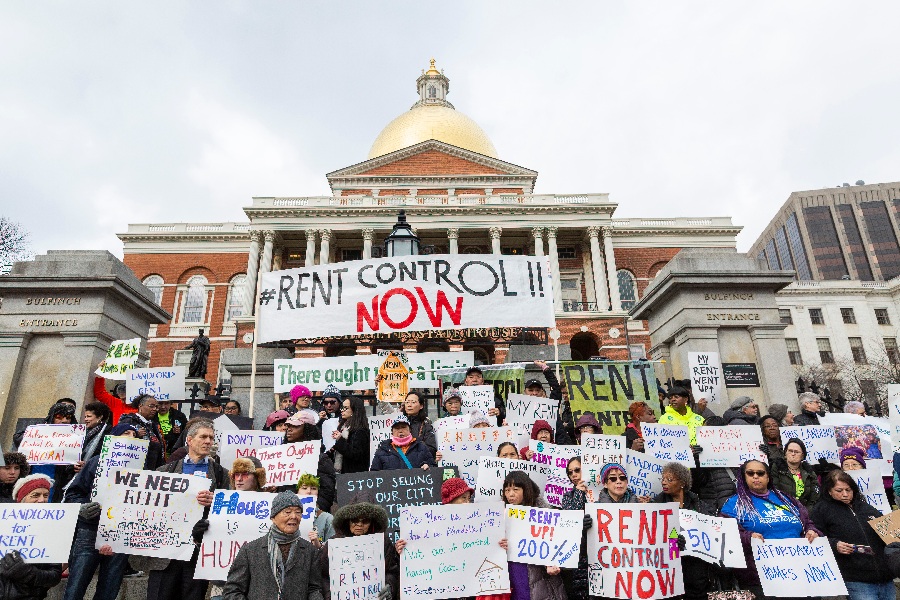
Rent control: The campaign behind a proposed 2026 ballot measure to establish rent control across the state says it has cleared the signature threshold, submitting what organizers describe as a “surplus” of voter support. Homes for All Massachusetts, the coalition driving the latest “Keep Massachusetts Home” initiative, reported Tuesday that it collected more than 124,000 raw signatures. The petition would limit annual rent increases for most units to either the annual Consumer Price Index increase or 5%, whichever is lower. It would use the rent in place as of Jan. 31, 2026 as the baseline for future changes. – Sam Drysdale
Starter homes: The campaign looking to “legalize starter homes” said Wednesday that it planned to submit more than 100,000 signatures. Legalize Starter Homes committee chair Andrew Mikula said he is “confident” about exceeding the signature requirement and said the proposal would “make it easier for first-time homebuyers, downsizing seniors, and working families to attain homeownership by updating outdated zoning rules that make modest homes nearly impossible to build.” The question would enable single-family homes to be built in any residentially-zoned area as long as the lot has at least 5,000 square feet of land, 50 feet of street frontage and access to public sewer and water services, according to the committee. Mikula said the committee collected around 103,000 signatures and anticipates having at least 82,000 certified signatures. – Ella Adams
State revenue cap: The measure that would change the limit on how much revenue the state can collect in a given year submitted 86,700 raw signatures, according to Jim Stergios, whose Pioneer Institute is working with the Massachusetts Opportunity Alliance to get the question onto the ballot. “We’re very comfortable where we are,” Stergios said. “The outpouring of support for this was super strong.” The proposal would limit state revenue each year to the net amount of state revenue from the year before, increased by a rate equal to the average growth of wages and salaries in Massachusetts over the most recent three years, according to a summary from the Attorney General’s Office. If revenue collected by the state in a given year exceeds that limit, the excess amount would be refunded to taxpayers the following year. – Ella Adams
Stipend reform: The campaign seeking to overhaul the Legislature’s stipend system says it collected 90,000 certified signatures, according to organizer John Lippitt, chair of the Legislative Effectiveness and Accountability Partnership. The group says legislative leadership use stipends to deliver $5 million to favored legislators, and calls the money “loyalty pay” intended to bind lawmakers to the wishes of leadership. Top Democrats say stipends reflect leadership responsibilities and allow lawmakers to think “about this job as a potential career.” – Sam Drysdale