

latest
Massachusetts Population Growth Slows to a Trickle as Immigration Plummets

BY ELLA ADAMS, STATE HOUSE NEWS SERVICE
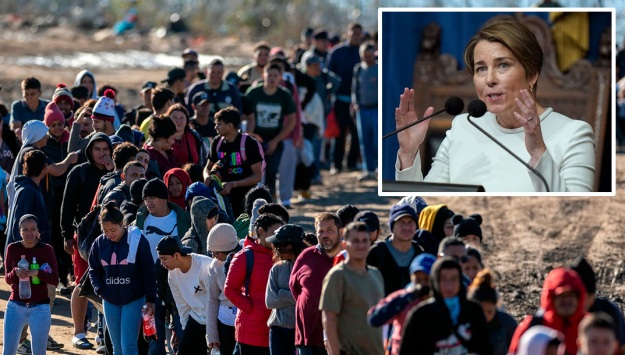
On the heels of federal estimates that reflect slowing population growth in Massachusetts, an expert on the topic cited dropping international immigration levels and long-term fertility trends as she told lawmakers that the drain could get even worse.
Immigration accounts for the biggest change in the state and nation’s population growth rate, Susan Strate, senior program manager for the UMass Donahue Institute’s Population Estimates Program, said Tuesday.
U.S. Census estimates released in January suggest Massachusetts’ population increased by about 0.2% between July 1, 2024 to July 1, 2025, to 7,154,084. The figure represents a slowdown in population growth compared to the previous year-over-year period, when Massachusetts saw its largest population increase in 60 years, almost 1%, between 2023 and 2024. It was fueled largely by high immigration levels.
Estimated net international immigration rates fell in Massachusetts in July 2025 to 40,240, compared to July 2024 at 77,957, Strate said. The Census Bureau named “a historic decline in net international migration” as the cause of slower overall U.S. population growth, showing a year-over-year increase of .5%.
Population growth is critical for any state but in Massachusetts in particular immigrants have played a major role across sectors over the years, helping to boost an economy where high living costs can deter new arrivals and cause longtime residents to look out of state for more affordable lifestyles.
The recent estimate captured six months during the Biden administration, and six months under the Trump administration, Sen. Will Brownsberger noted while chairing a Senate Committee on the Census hearing. He asked Strate whether the majority of those 40,000 immigrants came to Massachusetts during the first half of that timeframe.
“I’d hesitate to put numbers on it,” Strate said. “I’m not an expert on federal policy, but as you know — mass deportations, and also this kind of, death by a thousand paper cuts, where a lot of the administrative processes for people are getting much harder, much more difficult to navigate, a lot more barriers being put up.”
“Absolutely, we would expect that number to continue to drop,” Strate added, referring to the state’s net international immigration figure.
The Trump administration has accelerated deportations and taken actions that will “secure” U.S. borders and “end illegal immigration,” according to the Department of Homeland Security. The administration has escalated federal immigration enforcement tactics since the recent estimates’ cutoff in July 2025, and there are no signs that the approach will change in the nearly three years remaining on the president’s term.
Net immigration into Massachusetts has historically offset domestic outmigration. That held true in July 2025 estimates, which show that year-over-year immigration estimates still outweighed the estimated 33,340 people who left the state for other parts of the U.S., according to the Donahue Institute.
“Absent immigration, Massachusetts would already be losing population,” the Boston-based Pioneer Institute’s Economic Research Associate Aidan Enright said in a policy brief responding to the Census estimates. “Domestic out-migration rose again in 2025, and that’s a clear signal that the state is becoming less competitive as a place to live, work, and do business.”

Pioneer is among several groups that continue to warn about outmigration and are backing two tax-related ballot measures that could go before voters in November. Pioneer on Thursday released a report suggesting that domestic outmigration is “hollowing out” the state’s workforce and economy. The report also suggested Massachusetts lost an estimated 182,000 residents to net domestic outmigration from 2020 through 2025.
“We have sustained population growth entirely based on international migration,” Brownsberger told the News Service. “Over the past 12 months, international immigration has slowed to a trickle as a result of federal policy changes. That means that our projections of future population growth and future household formation need to be reviewed. All of our existing projections are based on immigration rates which are no longer to be expected.”
“It’s also hard to imagine the immigration trends will suddenly reverse, even if we have different policies coming from Washington,” the Boston Democrat added.
In longer-term projections, Strate tied fertility rates into the mix. The median age of millennials was about 34 years old in 2025, Strate said, and the peak fertility cohort is aged 30 to 34 years old in Massachusetts.
“For the next 10 years, the folks who are aged 20-to-24 now will be aged 30-to-34, so they will be passing through that higher fertility period. But then kind of looking forward 20 years, to 2045, there’s no next wave of large population coming behind them,” Strate said.
Population projections begin to start falling after 2035, she said, in part because the population aging into that fertile group is smaller. The combination of baby boomers aging, and millennials passing through fertile range is a “perfect storm” for increased death and declining birth rates, Strate added.
Declining immigration will reduce births even further in Massachusetts, she said, referring to 2024 American Community Survey data measuring births by year and mother’s nativity.
“I think it’s quite striking that by 2024, about 38% of all of the births in Massachusetts are to mothers who were born outside of the U.S. So you can kind of imagine if immigration continues to fall off, that births will also be undercut to the tune of 38% or more going forward,” Strate said.
Concerns about reaching immigrant communities for the Census have already been reflected upon by Brownsberger, and Secretary of State William F. Galvin recently cited concerns about “efforts now underway to limit the process and procedures for the count” in a reelection message.
While those count concerns and immigration projections are different issues, they’re linked in that they’re both a consequence of federal policy, Brownsberger said. It will be harder to count immigration populations, and those populations will be smaller, he said.
“The challenge in the 2030 census count is to include marginalized populations, especially immigrant populations,” Brownsberger said. “That’s always a challenge, but the events of the last 12 months have enormously reduced trust in immigrant communities and they’re less likely to stand up to be counted in the 2030 Census.”