BY ALISON KUZNITZ
Nearly 700,000 Bay Staters are facing the prospect of double-digit premium increases next year as insurers struggle to handle cost pressures across the healthcare landscape, possibly exacerbating affordability woes for patients.
Insurers in the merged market, where many individuals and small businesses get coverage, have proposed an average rate hike of 12.9% for 2027, according to plans posted online by the Division of Insurance. Insurers last year sought an average rate hike of 13.4%.
“This is just absolutely unaffordable — you know, four times the benchmark, more like five times the rate of inflation,” Retailers Association of Massachusetts President Jon Hurst said, referring to the statewide healthcare cost growth benchmark. “I am continuing to get more and more frustrated that there is just a lack of concern, not only within the healthcare industry but amongst our elected leaders, about what is happening to small businesses, to small employers on Main Street. Everybody’s seeing high increases, but small businesses have been getting far higher increases than big business or big government.”
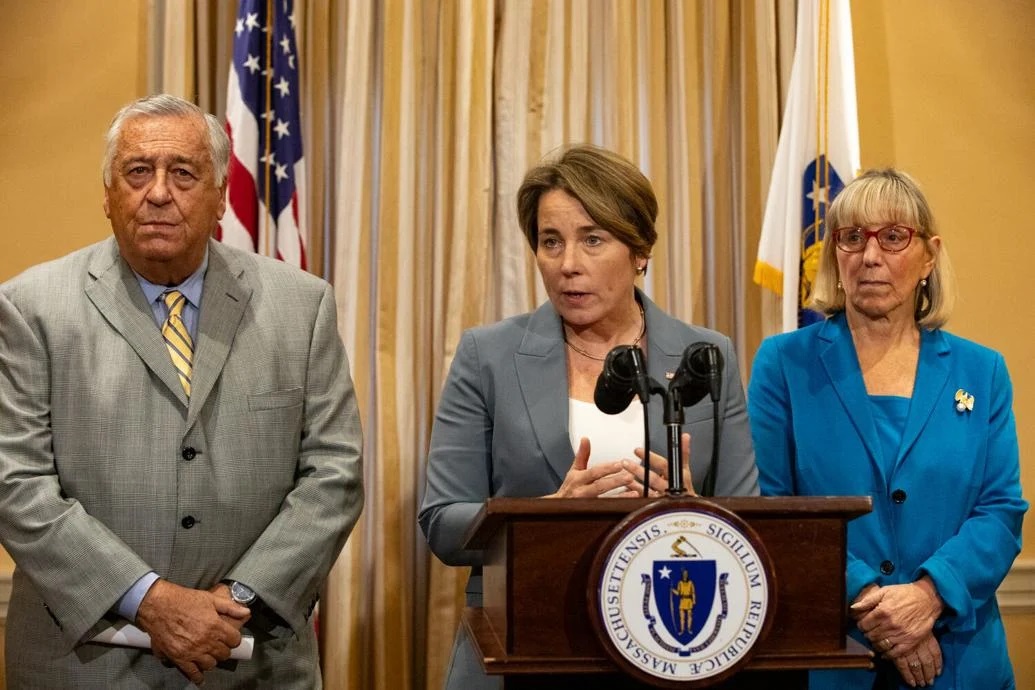
Last week, Gov. Maura Healey announced she’d instructed insurers in the merged market to limit cost-sharing increases to 3.6%, a move her office said would result in average annual savings of more than $230 as residents increasingly struggle to afford care and incur hefty medical debt. Insurance Commissioner Michael Caljouw also recently said that coverage is “increasingly out of reach and unsustainable” across the market.
Lora Pellegrini, CEO of the Massachusetts Association of Health Plans, said the 2027 rate proposals reflect the continued “acceleration in health care costs across Massachusetts,” as she pointed to “sharp growth” in hospital outpatient care, physician services and prescription drugs. The governor’s Health Care Affordability Work Group is expected to produce initial recommendations in June, and Pellegrini she’s hopeful that proposed changes “will rein in the underlying cost drivers in our marketplace.”
Blue Cross Cross Blue Shield of Massachusetts — which has the largest volume of enrollees at 166,384 — plans to increase premiums by an average of 15.3%. Tufts Health Public Plans, which trails closely behind at 160,566 members, wants to bump premiums by 11.8%.
Fallon Community Health Plan proposed the largest increase of 25.7% for its 29,641 members. Harvard Pilgrim Health Care pitched the smallest increase of 6.7% for its 79,318 members.
In its filing with the state, Blue Cross Blue Shield said costs for medical care and medications for members have “escalated rapidly,” with spending growing at the “fastest rate in more than a decade.”

“We are experiencing persistent utilization pressures across multiple service categories, most notably in outpatient surgeries (including digestive and cardiovascular surgeries), rising behavioral health visit volumes, and increased medical pharmacy use,” Blue Cross Blue Shield said. The insurer called out other cost pressures such as “blockbuster high-cost biologics,” emerging therapies, the state’s aging population and heightened use of “expensive specialty drugs.”
Fallon Health said its cost drivers include increased risk adjustment transfer payments and claim costs amid “anticipated morbidity changes due to federal and state policy, such as the expiration of enhanced premium subsidies.” The insurer said it “continually works to manage the cost of care” by managing medications through prior authorizations and “eliminating or minimizing duplicative, unnecessary, or inappropriate care.”
Under the proposed rate increases, Hurst estimates the average family plan will feature premiums topping $50,000 by next January. Hurst said he appreciates the governor’s effort to curb cost-sharing, but he said the strategy “doesn’t work unless you also say that the premiums can’t increase.”
“From our members’ perspective, it’s the total premium that’s killing them,” Hurst said. “You’ve got to cap out the premiums.”
Eileen McAnneny, president of the Employer Coalition on Health, said residents on fixed incomes who are hit with double-digit premium increases will struggle to afford other basic necessities like rent, food and energy.
“I mean, we can regulate the health insurance rates, which they did last year and probably will do again this year. But the problem is, until we actually get at the underlying cost of care, which are reflected in the ever-increasing premiums, then we’re not really going to solve this problem,” McAnneny said. “We have to find ways to deliver more efficient and more value-based care.”
The Division of Insurance last year rejected initial proposals from Blue Cross Blue Shield and WellSense Health Plan (also known as Boston Medical Center Health Plan) after regulators deemed hikes excessive.
Insurers will present their 2027 plans at a public information session on June 16, and rates will be finalized in August.