

Health
Massachusetts Governor Healey unveils plan to lower healthcare premiums, drug prices

Alison Kuznitz
STATE HOUSE, BOSTON, Aug. 3, 2026…..Gov. Maura Healey unveiled long-promised healthcare affordability recommendations Monday to expand MassHealth’s investment in primary care, slash premiums, rein in out-of-network costs, mitigate “low-value” care, leverage state buying power to reduce prescription drug costs, initiate an artificial intelligence regulatory process and more.
Healey intends to sign an executive order requiring that MassHealth invest 12% of its total medical spending into primary care by 2028, the governor’s office said. A Healey spokesperson said Monday afternoon the order will be issued “imminently.” In 2024, 8.4% of MassHealth spending was dedicated to primary care, according to a state dashboard.
House and Senate bills mapping out a primary care spending target were sent to conference committee talks Friday. Negotiators must figure out how quickly they want primary care to account for 15% of total healthcare spending, which entities would be subject to that target and what enforcement mechanisms would entail.
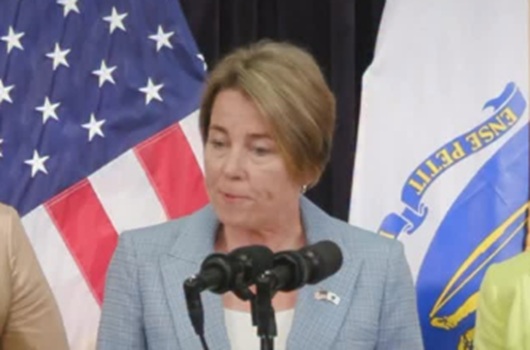
Healey voiced her support for that legislation Monday at Cape Cod Hospital, as her office promoted an initial slate of 12 recommendations from the Health Care Affordability Work Group that met confidentially for months and gave scant insight until now about its effort to solve one of the commonwealth’s biggest cost of living issues.
The governor announced the group’s creation at a State House press conference on Jan. 14, saying she wanted to see “some actual changes and recommendations no later than June.” In the meantime, Bay Staters are grappling with double-digit premium increases, high deductible health plans that are triggering steep out-of-pocket costs, and tough decisions to delay care due to affordability woes.
“We brought together leaders with different perspectives and expertise because everyone agreed on one thing—we have to make health care more affordable,” Healey said in a statement Monday. “These recommendations give us a roadmap to lower costs, strengthen our workforce and make sure people can continue getting the high-quality care they deserve.”
Joining Healey in Hyannis were Lt. Gov. Kim Driscoll, Insurance Commissioner Michael Caljouw, Massachusetts Health Connector Executive Director Audrey Morse Gasteier, Group Insurance Commission Executive Director Matt Veno, Health Policy Commission Executive Director David Seltz and Health and Human Services Undersecretary Amy Rosenthal. Health Care Financing Committee Co-chair Rep. John Lawn, who was not named to the primary care conference committee, was also there.
Healey said she’s directing the Division of Insurance to establish “default” out-of-network payment rates. The effort is meant to protect patients from surprise bills after they unknowingly receive care from providers who aren’t in their insurance networks, her office said. The DOI will hold listening sessions as it develops proposed regulations.
Healey is also charging the DOI to “evaluate bold, new strategies to strengthen competition and reduce premium costs in the merged market,” the governor’s office. Nearly 700,000 Bay Staters will see an average premium hike of 10.4% under rates regulators recently approved for 2027 in the merged market, where many individuals and small businesses get coverage. Insurance Commissioner Michael Caljouw says the “status quo is unacceptable.”
Prescription drugs, including expensive specialty drugs, are a top driver for healthcare spending growth. The work group wants the Executive Office of Health and Human Services, the Massachusetts Health Connector, the Group Insurance Commission and the Health Policy Commission to collaborate and develop a coordinated strategy for leveraging the state’s purchasing power in order to lower drug costs and improve access to medications.
Officials at the GIC, which stopped coverage for costly GLP-1 drugs for weight loss, have suggested a similar coordinated approach could help drive down the price tag for the popular drugs.
The work group wants the GIC, which provides coverage for more than 460,000 state workers and retirees, to play a role in managing hospital prices and lowering costs. Healey’s office says the GIC will set “standards for fair prices for some services without limiting where members receive care,” with undisclosed actions expected in the “coming months.” The administration did not point to specific solutions but noted prices “can vary widely between hospitals even for the same services and treatments, which drives up premiums for everyone.”
The HPC is tasked with overseeing a new clinical expert committee to tackle what the administration describes as “low-value or inappropriate services” that don’t necessarily improve patients’ health outcomes. The committee will develop goals, reporting requirements and accountability mechanisms for reducing those services, as well as offer payment incentives to “discourage inappropriate and costly care,” the Healey administration said.
Nearly one in four commercially insured residents received at least one of 17 low-value services tracked by the HPC, which translates into about $62 million in healthcare spending. Between 2022 and 2024, low-value service use climbed across four major categories: tests and procedures, imaging, drugs, and screenings, according to data discussed at a recent HPC meeting.
The work group has also advised shoring up the state’s health information exchange system, enabling more information to be shared privately across hospitals, doctors and insurers. The group plans to bring together healthcare data and technology experts to produce a data exchange framework and roadmap.
Mirroring guardrails embedded in the House’s primary care bill, the Healey administration said it intends to create an AI advisory work group as insurers and healthcare providers increasingly use artificial intelligence for coding, claims review and coverage decisions.
“Massachusetts should establish clear rules and transparency around how AI is used in these health care processes so decisions are fair, accountable, and do not cause errors, unfair denials, or delays in care,” Healey’s office said.
Additional affordability recommendations are broader, with some building upon recent grant funding. The Healey administration, for example, said it’s instructing state agencies to work with healthcare providers, health plans and experts to develop and deploy a strategy for accelerating the adoption of innovative care models and technologies.
Those models can reduce hospital or ED visits, Healey’s office said. The HPC recently announced $1.38 million for seven hospitals, aimed at supporting hospital-to-home programs and streamlining patient discharges to their homes rather than into skilled nursing facilities.
In another attempt to mitigate the clogged discharge process from acute care hospitals, the Healey administration said it will explore actions for modernizing surrogate decision-making and healthcare proxy laws.
“When patients remain stuck in acute care hospitals, they face added harm, hospitals lose capacity, and costs rise,” Healey’s office said. “Patients should be able to move smoothly to the next step in their care, not wait because of paperwork, approvals or bed shortages.”
At Cape Cod Hospital, Healey spoke about implementing a standardized discharge form to get rid of “needless paperwork.”
Without attaching concrete dollar figures, the administration said it is eyeing investments for nursing faculty recruitment and retention. Nursing programs are currently turning applicants away since they lack sufficient faculty and classroom capacity. Under potential consideration are scholarships, loan forgiveness and other approaches that lower financial barriers for nursing faculty.
To address broader healthcare workforce shortages, the administration said it will “build on investments” in training primary care providers, nurses, long-term care staff, behavioral health workers and community health workers.
The affordability work group met met privately for months, and the Executive Office of Health and Human Services has not shared meeting minutes or other materials with the News Service. Other special commissions operate more transparently, including the Health Policy Commission’s primary care task force that broadcast its meetings on YouTube and posted presentations on its website.
Health and Human Services Secretary Kiame Mahaniah told the News Service in March that he was expecting “meaty” recommendations to emerge between June and December. The group is “particularly interested in recommendations that can be put into law,” as well as “things that don’t need legislation because those are easier to do in a short period of time,” the secretary had said.
Jon Hurst, a task force member and CEO of the Retailers Association of Massachusetts, said the December recommendations need to dive into “more difficult issues on the inefficiencies, high costs and inflationary nature of the system.”
“Those decisions are going to be harder and more controversial, but will be extremely important for premium payers, taxpayers, and small businesses in order to deliver affordable and fair costs of living and costs of doing business in the Commonwealth,” Hurst said in a statement shared by Healey’s office.
Alison Kuznitz is a reporter for State House News Service and State Affairs Pro Massachusetts. Reach her at akuznitz@stateaffairs.com