
BOSTON – A Fall River, Mass. man was sentenced yesterday in federal court in Boston for drug distribution resulting in the death of a minor, as well as multiple other charges associated with his sale of drugs, machineguns and firearm parts on the Telegram app.
According to the Massachusetts Department of Justice, 27-year-old Benjamin Hunt was sentenced by U.S. District Court Judge Leo Sorokin to 23 years in prison, to be followed by five years of supervised release. In December 2025, Hunt pleaded guilty to one count of distribution of fentanyl, MDMA, MDA, Ketamine and LSD resulting in death; two counts of distribution of and possession with intent to distribute fentanyl; one count of distribution of and possession with intent to distribute 40 grams or more of fentanyl; two counts of unlawful transfer and possession of a machinegun; and one count of possession with intent to distribute 500 grams or more of a mixture and substance containing methamphetamine and cocaine.
Hunt was arrested and charged in August 2024 on drug and firearm charges and was later charged with additional crimes, including drug distribution resulting in the death of a minor.
From at least 2022 through 2024, Benjamin Hunt operated an online marketplace on the Telegram application through which he advertised and sold large quantities of controlled substances and firearms to customers across the United States. Hunt controlled multiple Telegram accounts and used the platform to conduct drug and weapons transactions while concealing his identity and seeking payment primarily in cryptocurrency.
Through his Telegram marketplace, Hunt offered for sale numerous dangerous drugs, including fentanyl, cocaine, LSD, MDMA, ketamine and counterfeit pharmaceutical pills made to resemble oxycodone but containing fentanyl. Hunt also advertised firearms and firearm components, including privately made firearms (“ghost guns”) and machinegun conversion devices (“switches”), some of which he manufactured himself using 3-D printing technology. Hunt typically required payment via Bitcoin, though in some instances accepted CashApp, and then shipped the contraband through the U.S. Postal Service, either directly or through suppliers.
In February, May and June 2024, Hunt sold counterfeit oxycodone pills containing fentanyl to an undercover law enforcement officer, including quantities exceeding 40 grams of fentanyl. During one of these transactions, Hunt simultaneously sold a privately made Glock-style firearm and multiple machinegun conversion devices along with an extended magazine and 3D printed brass knuckles.
In August 2024, Hunt mailed an additional package containing approximately 1,600 fentanyl pills to undercover law enforcement in exchange for cryptocurrency. Law enforcement intercepted multiple packages being sent to or from Hunt, including one package sent by him that contained a smoke grenade and one package sent to an address associated with him that contained 13 switches or machinegun conversion devices.
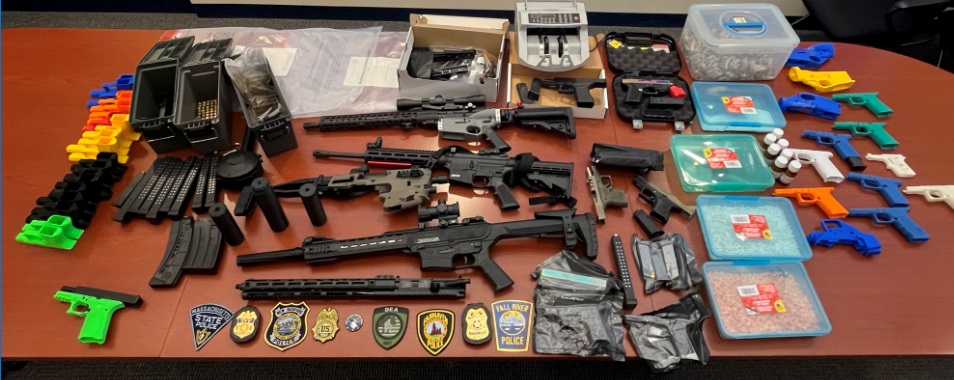
A search at Hunt’s residence resulted in the seizure of significant quantities of drugs, including fentanyl, cocaine, methamphetamine, MDMA and ketamine, as well as an arsenal of firearms and firearm components, including dozens of privately made firearms, machinegun conversion devices, silencers, extended magazines, large quantities of ammunition and 3-D printers used to manufacture firearm parts. In total, approximately 95 firearms and related items were seized.

Law enforcement in Massachusetts learned about an overdose death of an out of state 17-year-old minor in May 2023. Investigators uncovered evidence of Hunt having communicated with the victim through the Telegram app and offering various drugs for sale. The minor purchased multiple drugs from Hunt. Hunt sought payment in Bitcoin, but when the minor did not have access to Bitcoin, Hunt agreed to receive payment via Cashapp. Hunt then mailed drugs to the minor out of state through the U.S. mail.
Messages between Hunt and the minor in the hours leading to the minor’s death were uncovered, including messages discussing the minor’s consumption of drugs that had been supplied by Hunt. The drugs distributed by Hunt—including fentanyl, MDMA, MDA, ketamine and LSD—were determined to be the but-for cause of the minor’s death, which was ruled an acute mixed drug intoxication. As part of his plea, Hunt admitted that his distribution of these drugs resulted in the minor victim’s death.
“Benjamin Hunt’s decision to sell lethal drugs and guns online is the reason a family lost their child,” said United States Attorney Leah Foley. “This case is a stark reminder that drug dealers are no longer just on street corners. They are online preying on our children via phones and computers and pushing highly addictive and deadly drugs. We will continue track them down wherever they are and hold them accountable. Today’s sentence is warranted and a step in the right direction to ending the opioid epidemic.”
“Today’s sentence holds Benjamin Hunt accountable for a crime that ended a young life and forever changed a family,” said Special Agent in Charge Jarod Forget, New England Field Division. “Drug traffickers who distribute dangerous substances without regard for human life are fueling a public safety crisis in communities across Massachusetts and the nation. DEA and our law enforcement partners remain committed to identifying, investigating, and prosecuting those who profit from the distribution of deadly drugs. We hope this substantial sentence provides a measure of justice for the victim’s loved ones and serves as a reminder that those responsible for overdose deaths will be aggressively pursued and held accountable.”
“The severity of this sentence highlights the dangers of distributing both drugs and machinegun conversion devices. Independently, each has the potential to ruin lives and endanger the public. Taken together, Benjamin Hunt’s conduct could only lead to harm, and in this case a seventeen-year-old was killed as a result. Today’s sentence not only imposes a measure of justice but should serve to remind anyone considering selling fentanyl or machinegun conversion devices: you are responsible for the consequences of those actions,” said Thomas Greco, Special Agent in Charge of the Bureau of Alcohol, Tobacco, Firearms & Explosives, Boston Field Division.
“Today’s sentence sends a clear message: those who profit from poisoning and endangering our communities with drugs and guns cannot remain anonymous through the Internet. The U.S. Postal Inspection Service is relentlessly targeting the individuals and networks responsible for distributing deadly narcotics and firearms through the U.S, Mail. With strong enforcement, intelligence-driven investigations, and strategic partnerships, we are working every day to disrupt these groups and save American lives,” said Jason Buckley, Acting Inspector in Charge of the U.S. Postal Inspection Service’s Boston Division
U.S. Attorney Foley, DEA SAC Forget, ATF SAC Greco, USPIS Acting INC Buckley, New Bedford Police Chief Jason Thody and Fairhaven Police Chief Daniel Dorgan made the announcement. Valuable assistance was provided by Homeland Security Investigations in New England; the Massachusetts State Police; and the Attleboro, Fall River, Norton, Scituate and Taunton Police Departments. Assistant U.S. Attorneys Kunal Pasricha and J. Mackenzie Duane of the Criminal Division prosecuted the case.
This case is part of the Homeland Security Task Force initiative established by Executive Order 14159, Protecting the American People Against Invasion.