

BY ELLA ADAMS
STATE HOUSE, BOSTON, SEPT. 16, 2025…..In the midst of gun violence news again overtaking national and local headlines, gun safety advocates are pitching lawmakers on a proposal that would give victims a path to litigate against the industry and require firearm manufacturers and dealers to operate under an established standard of conduct.
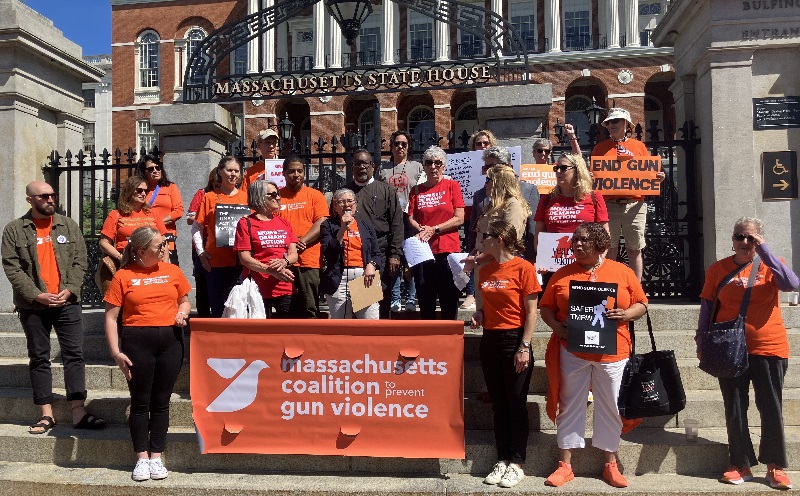
“This has been a difficult week in the gun violence world, with the news nationally certainly impacting how we are able to talk about what, in fact, does keep us safe and what does not, but also locally,” Ruth Zakarin, executive director of Massachusetts Coalition to Prevent Gun Violence, said at a State House policy briefing.
Last Wednesday, conservative political figure Charlie Kirk was assassinated while speaking at an event at Utah Valley University, prompting national reaction. That same day, there was also a shooting at a high school in Evergreen, Colorado, and a lockdown at UMass Boston after there were reports of shots fired on campus.
Supporters of Massachusetts gun safety laws say they are among the strongest and most successful in the nation, though critics often claim the regulations burden law-abiding gun owners with excessive requirements. Legislation filed by Sen. Cindy Creem and Rep. Frank Moran (S 1653, H 2672) would add Massachusetts to the list of states that have established a “concrete list of responsibilities” that manufacturers, dealers, wholesalers and others involved in disseminating firearms must follow, Everytown Policy Counsel Elisabeth Ryan said.
The requirements aim to ensure those who sell guns keep their inventory secure, or not knowingly sell guns to people who will traffic them, the former Executive Office of Public Safety and Security counsel added. The proposal would also enable the attorney general’s office to bring a suit against anyone who violates those requirements, and enable people who have been directly harmed by gun violence to pursue litigation against the industry.
“Basically, the argument has always been, ‘Well, we’re not responsible for the criminal. When somebody else takes a gun and uses it criminally, that has nothing to do with us,'” Ryan said of the firearm industry. “And this is saying, ‘No, it does have something to do with you, because if you contribute to getting it there unlawfully, then you can be held responsible for that.'”
A federal law passed in 2005 called the Protection of Lawful Commerce in Arms Act (PLCAA) shields firearms manufacturers and dealers from lawsuits against them regarding criminal misuse of a firearm, GIFFORDS Law Center senior litigation attorney Billy Clark said. The law provides broad “immunity” for the industry, Clark added, so individuals aren’t able to pursue claims against it for its role in causing harm against them.
“PLCAA continues to be incredibly dangerous for several reasons. The first is, it simply prevents justice to victims and survivors, families who have lost people because of design defects in guns, for example,” said Tanya Schardt, senior director of state and federal policy at Brady Center to Prevent Gun Violence, said.
The new legislation would attempt to give people a pathway to holding the industry accountable, Schardt said, including Black and Brown communities that have been disproportionately impacted by gun violence and people who have died due to trafficked firearms.
According to Gun Owners Action League (GOAL) Executive Director Jim Wallace, the legislation promoted Tuesday has “nothing to do with victims of violence.”

“We don’t allow Chevy to be sued because of drunk driving — people don’t even sue alcohol companies for drunk driving because it’s an abuse of their product. You can’t sue an industry,” Wallace told the News Service. According Wallace, who leads the gun rights nonprofit, the reason the 2005 federal law went into effect was to protect the firearm industry from being sued into bankruptcy.
New York was the first state to pass “industry accountability” legislation in 2021, requiring firearms companies selling guns to follow certain business practices as a way to try to prevent dangerous sales. While the law was almost immediately challenged by gun rights advocates on constitutional grounds, the state’s highest court upheld the law in July. There have been eight other states that have followed suit in passing similar laws since 2021, according to advocates.
“It really has been the passage of these industry accountability bills that has reshaped the ability to go after the gun industry for their negligence and their irresponsible behavior,” Schardt said.
She said it’s “imperative that states step up” to pass regulations considering shifting federal oversight under the Trump administration.
“We’re seeing calls for cuts [to] funding, cuts to an agency that’s already been drastically underfunded for decades — intentionally, to make sure that there’s not appropriate oversight in the gun industry,” Schardt said. “We can assume that [the Bureau of Alcohol, Tobacco, Firearms and Explosives] is not going to be engaging in proper, meaningful or robust oversight of the gun industry in any way, shape or form.”
The federal administration has moved in recent months to make broad changes to the bureau as a way to “reduce ‘unnecessary regulatory burdens,'” as reported by NPR.
Massachusetts overhauled its firearms laws in 2024, aiming to address things like 3-D printed guns and “ghost guns,” and to update the state’s “Red Flag Law.” Opponents of the law claim it violates Second Amendment rights, and have put a referendum on the 2026 ballot that will let voters decide whether to keep the statute.
Wallace called the 2024 law “a flat-out attack on the Second Amendment community,” and said the proposal promoted Tuesday “is no different.”
It’s not certain whether the Legislature has an appetite to pass more gun-related legislation this session while the broader debate about the 2024 law begins to unfold.
Asked about advocates’ strategy this session considering such opposition, Zakarin said, “It’s always about we can move this work forward in Massachusetts. There’s always more we can do to keep the residents of the state safe from gun violence. And while we were thrilled to get the 2024 law passed, this was not a policy that was included. And so for me, it is around the urgency of continuing to strengthen our policies, to continue to commit to this work, for Massachusetts to continue to be the leader that it has been.”
A recent report on firearm-related activity from the Executive Office of Public Safety and Security found that a firearm was used in more than 13,400 crimes in Massachusetts over the course of 2022 and 2022 — a nearly 14% increase over the two-year period before. Officials attributed the figure to an increase in violations of state laws related to the manufacture, sale, purchase, transport or possession of guns.