
Question 8 money: nearly every dollar for Massachusetts marijuana repeal comes from a single Virginia nonprofit


The campaign asking Massachusetts voters to end legal recreational marijuana sales is, financially, almost a one-donor operation and doesn’t even have to disclose who is funding them.
Of the $3,531,625 the Coalition for a Healthy Massachusetts has raised since it formed in September 2025, $3,480,000 — 98.5 percent — came from SAM Action Inc., according to the committee’s filings with the state Office of Campaign and Political Finance. SAM Action is the political arm of Smart Approaches to Marijuana, an anti-legalization advocacy group based in Alexandria, Va.
The coalition is the only committee registered in support of Question 8 on the Nov. 3 ballot. The measure would repeal the laws that legalize, regulate and tax retail sales of adult-use marijuana; a YES vote ends recreational sales, a NO vote keeps them. Medical marijuana would stay legal either way.
Who is SAM Action?
Smart Approaches to Marijuana was founded in 2013 by former U.S. Rep. Patrick Kennedy and drug-policy analyst Kevin Sabet, who is its president and CEO. It campaigns against commercial marijuana nationwide from offices in Alexandria, Va., just outside Washington, D.C. SAM Action, the arm funding Question 8, is a 501(c)(4) “social welfare” nonprofit.
Where SAM’s money comes from
The coalition itself reports every dollar to the state, and SAM Action is named as the source. What voters can’t see is one layer up: SAM Action isn’t required to disclose its donors, and it doesn’t — a type of political spending often called dark money. That’s legal for a nonprofit of its kind.
Its most recent tax return, for 2024, gives a sense of scale. SAM Action took in $8.6 million in contributions that year, spent $1.17 million, and ended 2024 with $23 million in net assets, according to the filing on ProPublica’s Nonprofit Explorer. On its contributor schedule, the names and amounts of donors are marked “restricted,” as federal law allows for nonprofits of its type.
The same return shows how SAM Action spends on ballot fights. In 2024 it reported three grants: $128,600 to the Coalition for Safe Communities in Beverly, which fought Massachusetts’ psychedelics question; $100,000 to Keep Florida Clean, which opposed Florida’s legalization measure; and $10,000 to a Colorado group called Protect Our Kids. With $23 million in reserve at the end of 2024, SAM Action can afford its Massachusetts spending several times over.
SAM says its money comes mainly from individuals and families who have seen marijuana’s harms firsthand, along with family foundations and speaking fees. It says it takes no money from the alcohol, tobacco, opioid or prison industries, but there is no way to confirm that. Sabet has said the group keeps donors private to protect families from harassment.
Online critics have suggested alcohol or tobacco interests are behind the repeal. New England Public Media reported it found no evidence connecting SAM or Question 8 to either industry.
The group has been here before. SAM Action’s 2024 grant to the Coalition for Safe Communities went to oppose Massachusetts’ failed psychedelics question. It also set aside about $2 million for a similar repeal effort in Maine that did not reach that state’s ballot, the Boston Globe reported.
Sabet told NEPM that Massachusetts families affected by legalization approached SAM, and that the group invested knowing the measure might lose.
How the money arrived
SAM Action made five contributions to the coalition: $750,000 on Sept. 23, 2025, and $800,000 on Oct. 8, 2025, while signatures were being gathered; then $875,000 on May 8, $750,000 on July 15 and $305,000 on Sept. 29 of this year.
Only one other organization has given: Americans Against Legalizing Marijuana, of Carmichael, Calif., which contributed $50,000 on Sept. 15. Massachusetts residents have given $1,625 in total — $1,600 itemized from five people in Newton, Westwood, Manchester and Stoneham, plus $25 in small unitemized gifts. That works out to less than one-twentieth of 1 percent of the campaign’s money.
The coalition has spent about $2.7 million so far: $1.44 million in 2025, mostly during the signature drive, and $1.26 million this year. It reported $831,945 in cash on hand as of Oct. 1, according to its latest OCPF report.

The local face of the campaign
The coalition’s chair is Wendy Wakeman, a Massachusetts Republican strategist. She has described the group as concerned about public health, especially for young people.
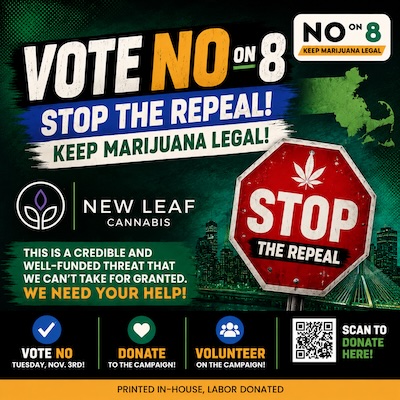
Opponents have made SAM’s role a central attack, arguing the repeal is being driven by out-of-state money. Ryan Dominguez, who chairs the Stop the Repeal campaign and runs the Massachusetts Cannabis Coalition trade group, has said the debate was manufactured by SAM’s spending.
The other side’s money
The NO side has raised less overall — $2.36 million across four committees — but it now has more money left to spend. The main opposition committee, the Committee to Protect Cannabis Regulation, reported $1,153,610 in cash on hand as of Oct. 1, about $320,000 more than the repeal campaign, after spending $1.04 million this year. Its biggest checks come from the cannabis industry: INSA ($265,000), Ascend Wellness Holdings ($250,000) and Vireo Health ($125,000), along with Evergreen Strategies LLC and the Retailers Association of Massachusetts ($100,000 each).
Those companies stand to lose their Massachusetts retail business if the measure passes, and some are based out of state themselves. INSA is an Easthampton-based cannabis company, and Evergreen Strategies is a state-licensed marijuana product manufacturer. But Ascend Wellness Holdings is headquartered in New York City, and Vireo Health is based in Minneapolis.
What’s at stake statewide
If Question 8 passes, Massachusetts would become the first state to repeal legal recreational sales, a decade after voters approved them with about 54 percent of the vote in 2016. Medical marijuana and limited personal possession would remain legal.
The economic stakes
State data show how large the recreational market has become. Licensed marijuana establishments sold a record $1.65 billion of adult-use cannabis in 2025, across 46.3 million transactions, according to the Cannabis Control Commission. Cumulative sales passed $8 billion last June. As of November 2025, 416 retailers and delivery businesses were operating, and about 21,000 people held state agent registrations to work in the adult-use and medical industries.
The tax take is substantial. The state collected about $280 million from recreational sales in fiscal 2025, and cities and towns about $50 million more through local taxes of up to 3 percent, according to the Executive Office of Administration and Finance’s estimate in the state voter guide. State and local marijuana taxes have brought in more than $1.4 billion since sales began in 2018, commission data show.
Much of that money is earmarked. The state’s Marijuana Regulation Fund, which collects the marijuana excise tax and license fees, budgeted about $125 million for public health and substance-addiction programs in fiscal 2025, along with money for re-entry programs, community college equity scholarships and grants to communities hurt by past drug enforcement, according to the commission.
If it goes away
Repeal would take effect Jan. 1, 2028, under the ballot measure. The state’s fiscal statement says only that state and municipal tax receipts would fall; no state agency has published a full economic-impact estimate of repeal.
The measure gives existing businesses one path: it directs the commission to fast-track adult-use licensees that want to become medical dispensaries and let them sell remaining inventory to the medical market. That market is much smaller. Medical dispensaries sold $225.5 million in 2024, compared with $1.64 billion in adult-use sales that year, commission figures show.
Opponents say repeal would eliminate more than 20,000 jobs and push buyers to the illicit market or neighboring states. That figure is close to the commission’s count of about 21,000 registered workers, which also includes people in the medical market, which would continue.
Supporters counter that the revenue doesn’t cover the costs. In their official ballot argument, they say taxpayers spend $4.50 dealing with legalization’s effects — health care, lost productivity and crime such as impaired driving — for every $1 in tax revenue. The argument doesn’t cite a source; the same ratio appeared in a 2018 study of Colorado by Colorado Christian University’s Centennial Institute, which industry groups criticized as not peer-reviewed.
Closer to home
The NO side’s second-largest donor, Ascend Wellness Holdings, owns Ascend Cannabis in neighboring New Bedford. Fall River, which collects a 3 percent local tax on recreational sales, would lose that revenue if the measure passes. Little of the campaign money is local: Fall River retailer New Leaf Enterprises gave the NO side $5,045 worth of banner and bollard signage on Sept. 30, and the repeal campaign reports no SouthCoast donors.
Polling has shown the repeal trailing, including a September University of New Hampshire poll in which 71 percent of voters said they planned to vote no. Raising or spending more does not guarantee a win, and these figures say nothing about the merits of either side.
At a glance
| Side | Raised since 2025 | Spent since 2025 | Cash on hand (Oct. 1) |
|---|---|---|---|
| YES (1 committee) | $3,531,625 | $2,699,680 | $831,945 |
| NO (main committee) | $2,343,622 | $1,036,237 | $1,153,610 |
| NO (3 small committees) | $14,117 | $2,086 | under $15,000 |
| Top organizational donors | Side | Amount | Who they are |
|---|---|---|---|
| SAM Action Inc. | YES | $3,480,000 | Political arm of Virginia-based Smart Approaches to Marijuana |
| INSA | NO | $265,000 | Cannabis company, Easthampton |
| Ascend Wellness Holdings | NO | $250,000 | Multistate cannabis operator, New York; owns Ascend Cannabis in New Bedford |
| Vireo Health | NO | $125,000 | Multistate cannabis company, Minneapolis |
| Evergreen Strategies LLC | NO | $100,000 | Licensed Mass. marijuana product manufacturer |
| Retailers Association of Massachusetts | NO | $100,000 | Statewide retail trade group |
| Americans Against Legalizing Marijuana | YES | $50,000 | Anti-legalization group, Carmichael, Calif. |
To see where you stand on the question itself, try MassVoter’s Question 8 quiz.