
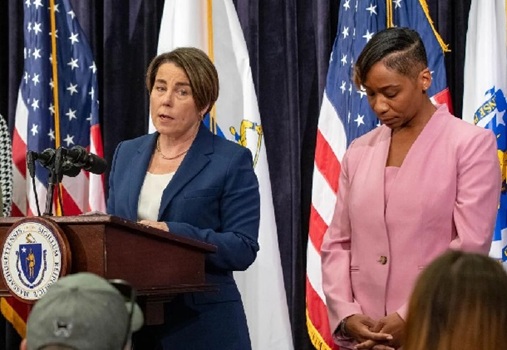
Tell me if you’ve heard this joke before: “How do you know if a politician is lying? His lips are moving.”
This is true when it comes to Massachusetts politicians stating that the 72%-voter approved audit is unconstitutional. Opponents (mostly the legislators who would get audited), state that it’s unconstitutional for the executive branch to audit the legislative branch, but as State Auditor Diana DiZolgio has pointed out, the legislative branch through their committees audit other branches. Also, a little research shows that all ballot questions are review for constitutionality before signatures for ballot approval are even collected.
A record 72% of voters approve the audit
In November of 2024, voters overwhelmingly approved the ballot question that would allow the State Auditor to audit the legislators. The legislators have taken no action to turn the ballot question into legislation and have only acted to block the ballot question from becoming law.
For some perspective, in November of 2016, 53% of Massachusetts voters approved marijuana recreational sales like alcohol. Marijuana was and is still federally illegal, but that didn’t stop legislators from working on marijuana legislation the following month. Then a few months later on July 19, 2017, worked to convert the ballot into legislation. Retail licenses began to be issued on January 1, 2018. It would have been easy to not allow recreational marijuana sales: the ballot question barely passed and the federal government classifies marijuana the same as heroin. But ballot questions become law based on political will and benefit, not based on legality or popularity. With marijuana, the state gets to collect massive taxes. With audits, we the people, get to peak into possible legislative fraud.
What does the official Commonwealth of Massachusetts website say about ballot questions
The majority of Democrat politicians, from the governor to the attorney general to local politicians like Michael Rodrigues and Carole Fiola, state that the state auditor auditing the legislator is unconstitutional, but the official Mass.Gov website shows that ballot questions are reviewed as constitutional before petitioners are even allowed to collect signature. Ballot question petitioners aren’t even allowed to collect signatures unless the Massachusetts AG approves the ballot question based on a rigorous constitutional review.
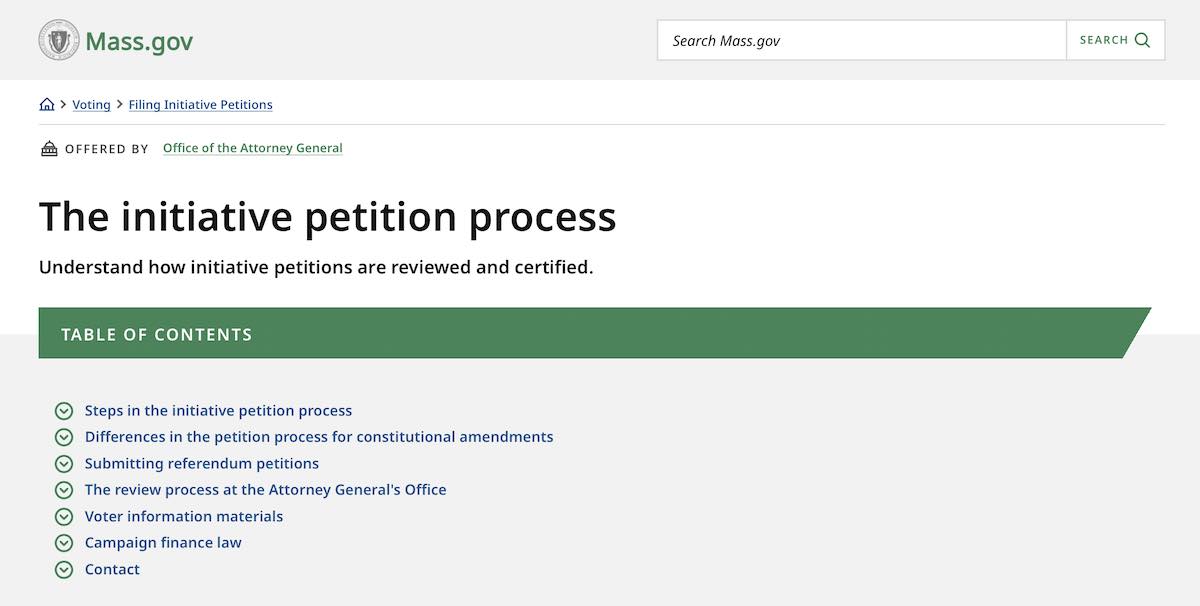
As you can see, I’m using the official ballot question process offically called The initiative petition process at the Office of the Attorney General section on Mass.gov.
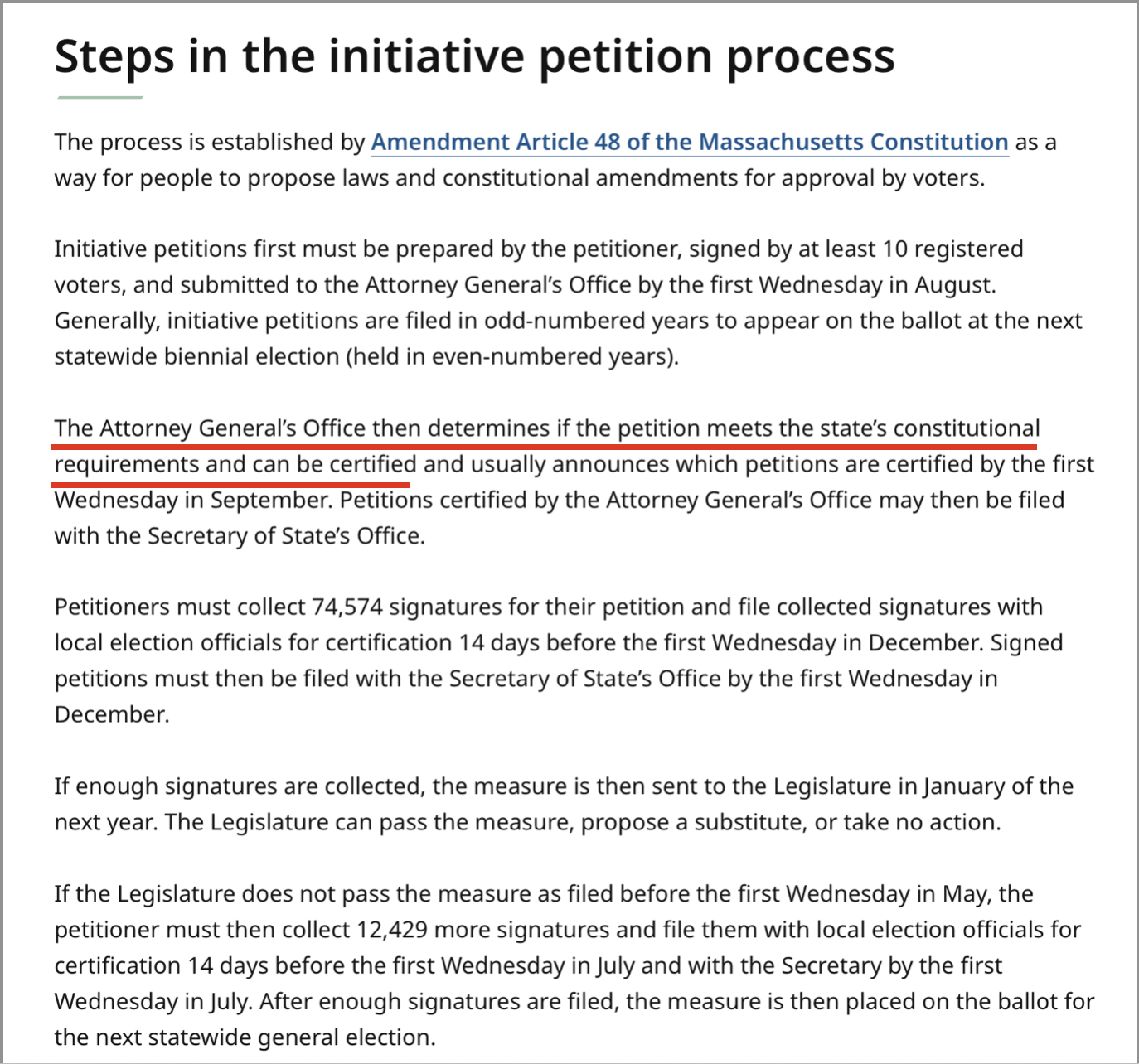
Very early in the process of getting a ballot question approved, the AG does a constitutional review: “The Attorney General’s Office then determines if the petition meets the state’s constitutional requirements and can be certified …”
What kind of review is done? Let’s look at the official Mass.gov website titled Constitutional requirements for initiative petitions.
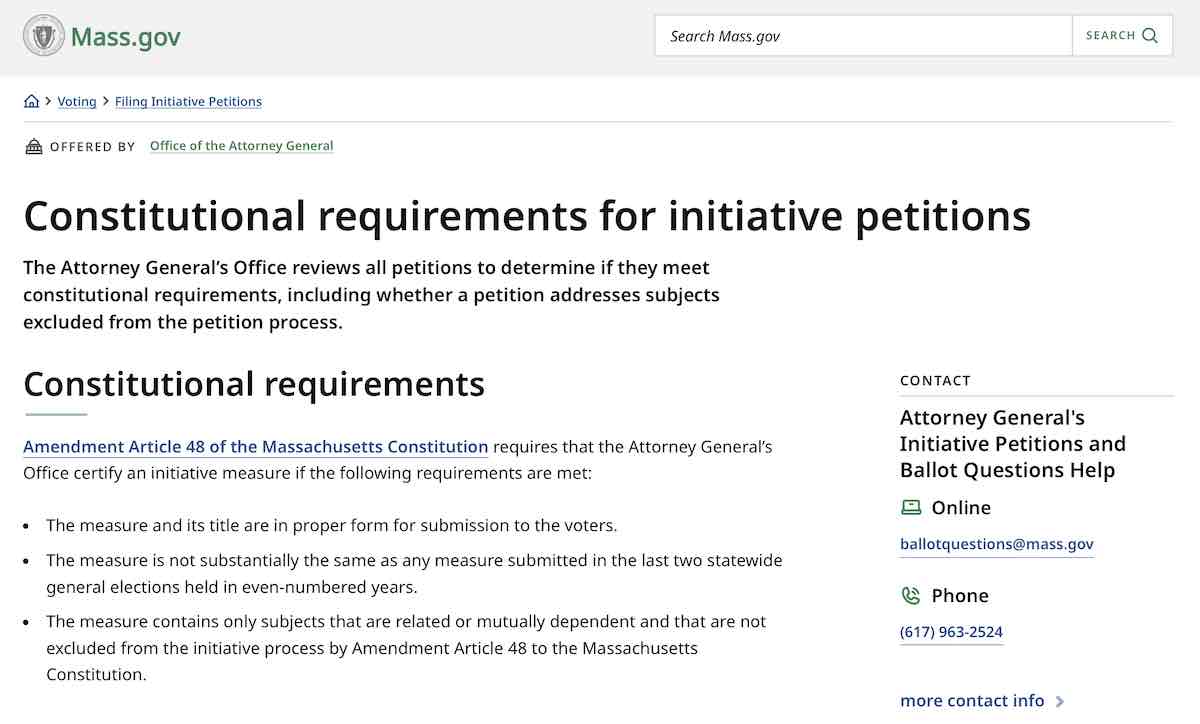
You’ll notice two sections, first Constitutional Requirements:
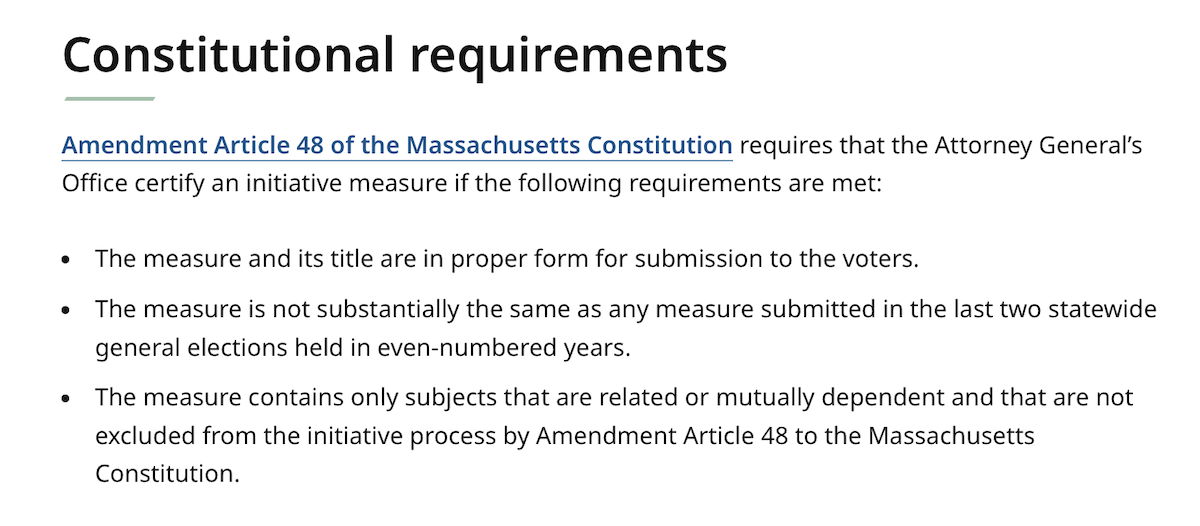
The AG review these main areas: 1) proper form, 2) ensuring a new measure is not the same as past ballots and 3) reviews subjects excluded by the Massachusetts constitution. Democrat state legislators keep pointing to point 1 proper form, while ignoring points 2 and 3.
Let’s review point 3 and you’ll see a long list of “Excluded Matters” the AG reviews to ensure ballot questions are consitutional or unc.onstitutional
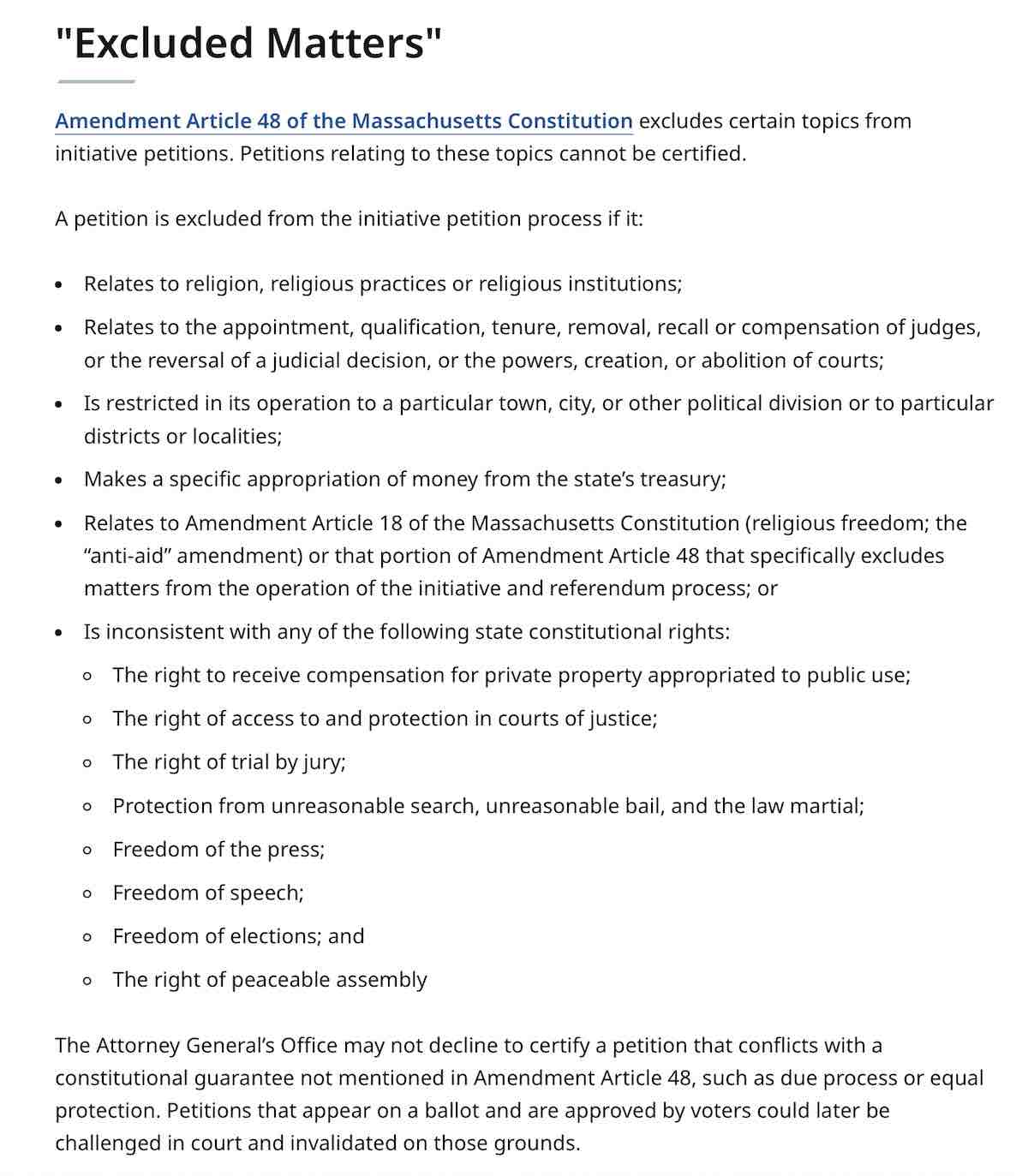
As you can see, the Massachusetts AG does a thorough constitutional review of ballot questions before the petitioner is even allowed to start collecting signatures. If the ballot question to audit the legislators by the state auditor was unconstitutional, why did Massachusetts AG Campbell approve it for signatures? Why was it allowed to be voted on if it’s unconstitutional as Democrat legislators claim? Why do ballots like the one to legalize recreational marijauna, which is federally illegal, and barley approved by the voters is converted to legislation quickly, but ballots deemed constitutional by the AG and approved by 72% of the voters blocked from becoming legislation? With three Democrat Speakers of the House in a row going to jail for corruption, Democrats should be willing to open their books, but they are not.
Unknown Management consultants provide a clue of why the audit is being blocked
Recently, Massachusetts State Auditor Diana DiZoglio has highlighted a striking case of limited transparency in state government spending. The Massachusetts Senate spent approximately $1.95 million on management consultants over a roughly two-year period, yet no specific vendors, contracts, or detailed purposes appear in readily accessible public records.
“These are the kind of things I’ve been trying to audit but haven’t been given access to,” DiZoglio stated, using the figure to illustrate broader challenges in overseeing legislative expenditures.
In Conclusion
Anyone who states that 72% voter-approved audit is unconstitutional, is either ignorant or lying. The official process starts out with the Massachusetts AG, the state’s top lawyer, reviewing ballot questions for constitutionally before petitioners are even allowed to collect signatures. Massachusetts legislators will allow ballot questions that go against federal law and barley pass by 53% to become legislation (like legalizing marijauna), but not 72% voter approved ballots that were approved as constitutional by the state’s top lawyer. Everyone should be asking why that is.