

By Katie Castellani.
A new poll shows 84% of survey respondents strongly or somewhat support eliminating the statute of limitations for filing a civil complaint alleging child sexual abuse, a policy that’s made progress in the Legislature and has a shot at reaching Gov. Maura Healey’s desk this year.
The MassINC Polling Group poll commissioned by Herman Law was released on Thursday by Enough Abuse, a nonprofit that has called for stronger remedies for survivors. Pollsters surveyed 802 Massachusetts registered voters online from Sept. 14 to Sept. 19.
The poll showed cross-party support for eliminating the statute of limitations with 74% of independent respondents supporting it along with 85% of both Democrat and Republican respondents. The poll found 79% of respondents want their lawmaker to vote in favor of eliminating the statute of limitations and 67% said the policy should be a high priority.
Attorney General Andrea Campbell last week released a scathing 203-page report concluding that more than 270 Catholic clerics abused 944 children within the Catholic diocese of Fall River, Springfield and Worcester.
Eliminating the statute of limitations was one of the legislative recommendations Campbell issued along with the report.
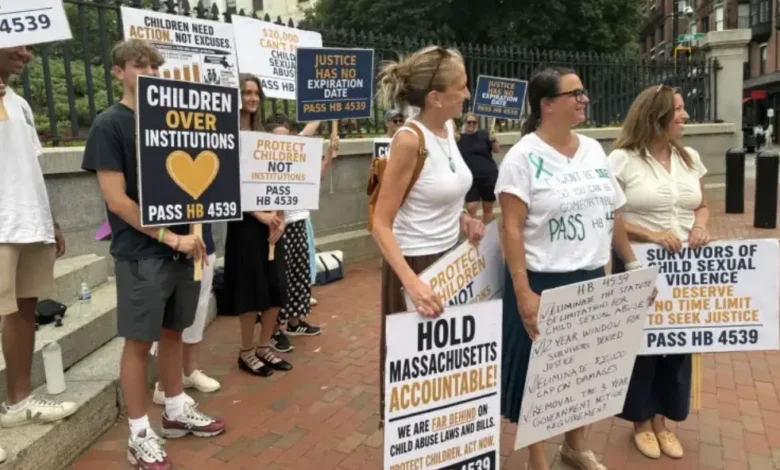
Lawmakers are negotiating primary care legislation and the House’s version includes language to eliminate the statute of limitations. Sen. Joan Lovely is sponsoring a bill (S 1169) with similar provisions. The bill has been in Senate Ways and Means since July 2025. Another bill that’s similar to Lovely’s legislation (H 4539) is a Joint Committee on the Judiciary redraft of several bills and has been pending in the House Ways and Means Committee since September 2025.
The state’s current statute of limitations is 35 years, a period that begins when the alleged victim turns 18 years old.

Lovely, who has been open about her experiences as a victim of child sexual abuse, called the poll results “staggering” and said the results can help more people feel comfortable discussing the topic and legislative reforms.
“Let’s put it this way: I’ve been working for the last almost 14 years in the Senate to talk about this. It’s the most uncomfortable subject that you can talk about. People don’t want to talk about it. They shut down and they say it doesn’t happen in my world,” Lovely said during a virtual press conference Thursday. “And so it’s been a big education piece for the last, you know, since I’ve been in the Senate to again, get to this moment, and I believe we are here.”
Pending bills would also open a two-year period where survivors can revive claims that expired under the current statute of limitations. The poll found 91% of respondents agree that survivors of child sexual abuse may need many years before they are ready to share what happened.
Also, 93% of respondents agreed that organizations that knowingly enable sexual abuse and fail to protect children should be held accountable. Three percent of respondents somewhat or strongly disagreed and 4% were unsure.
Asked if they or someone they know has ever been sexually abused as a child, 36% of respondents said yes and 45% said no, 11% preferred not to say and 8% were unsure. Also, 59% of respondents said child sexual abuse is somewhat or very common in the state and 27% said it is not too common or not common at all. The remaining 14% were unsure.
Catholic church groups across the country have opposed similar legislative reforms, arguing the move could saddle them with the responsibility and liability of defending against claims that are decades old. In 2014, when the Legislature was discussing extending the statute of limitations from three years after an alleged victim turns 18 to 35 years, lawmakers said they sensed more support from the Church. A representative for the Massachusetts Catholic Conference did not respond to the News Service’s inquiry.
According to WBUR reporting, the Massachusetts Insurance Federation opposes eliminating the statute of limitations because entities facing allegations, and their insurers, may not be able to access information needed to defend themselves.